Monday, 23 September 2013

10 Ideas / Innovations for Induction (sponsored by iCIMS)

Screen Shot 2013-09-23 at 22.15.12.png

I seem to have been posting quite a bit on recruiting recently, which I guess is natural, given the recent growth in activity recently.

But what about induction?  We’re not going to get the returns we need from recruiting if we’re not onboarding new hires effectively.  And after a lull in recruiting activity it could be a good time to take induction off the shelf and give a dust over.

Here are 10 ideas for putting a bit more oomph in the way you may be inducting currently:

1.   Have some clear objectives for what you hope to achieve.  It’s useful to provide some KPIs you can measure against. It will also help ensure you can focus on the things that are going to make the biggest difference to someone’s potential and success.

2.   Probably the biggest shift can often be just raising the level of ambition about what you’re trying to do.  Don’t just focus on activity, set the goal of achieving some stretching and useful outcomes to raise the level of the bar in terms of the capability of people working in the organisation!

3.   Ensure induction and recruiting are well integrated.  This covers two objectives, Firstly, it’s about doing the simple things well - ensuring that new hires get the induction that need, when they need.  Secondly, it’s about allowing you to make more nuanced decisions in your talent management.  For example, allowing you to compare an excellent candidate who fits all of your specifications, but who might be quite expensive, with someone who doesn’t quite fit the bill - but with the right induction and onboarding, could be a star performer, and would be significantly cheaper too.

4.   Guide rather than assess your new joiners through their induction, training and probation.  Don’t expect them to fail and don’t worry too much about catching them if they do.  Put your effort into supporting them to ensure that they don’t!

5.  Personalise the support.  Don’t treat everyone the same - we’re not, so don’t act like we are.  I loved this research from Harvard Business Review  –that focuses on finding and emphasising the importance of focusing on peoples’ strengths.  Find out what they can do, what else they need, and then, deliver it.

6.  Start referrals!  The best time to generate employee referrals is often before your new hires’ existing contacts start to reduce both in numbers and depth of the relationships involved.  Help your new starters spread the word that they’re joining you, and you may find some more great people too.

7.   Think about the team!  You may only be inducting one person now, but it’s not just that person that’s going to have to change.  One new person means a whole set of altered relationships.  Broaden the focus to the other people they’ll be working with - how can you ensure they’re onboard and ready to work with the new hire too?

8.   Make it social!  This is partly about helping new hires use social tools to find out about company information, and make the contacts that they’ll need.  But it’s also about getting them using social tools as well.  Have them tweet / blog or otherwise update on their experiences - it’s a great way for other employees to get to know them and does wonders for their own learning experience as well.

9.   Make it fun!  Induction can be deathly but it doesn’t need to be.  Give your new recruits challenges and activities, games and assignments.  This doesn’t need to involve gamification but it probably shouldn’t involve a big, heavy manual to read either!

10.   Use technology. Technology is never the full answer to anything, but it’s an increasingly big part of the response to most questions.  Most of the other ideas listed above will be that much easier to implement with a sound recruiting and induction platform in place.


This post is sponsored by iCIMS.

iCIMS is the leading provider of talent acquisition software for growing businesses. Through the implementation of easy-to-use, web-based solutions, the iCIMS Talent Platform helps organisations manage everything from sourcing, to recruitment, to induction all within one streamlined application.

Check out a free walk-through of the iCIMS system or make contact at +44 (0) 118 9000 706 or europeansales@icims.com.


Technorati Tags: , , , , , , ,

Friday, 20 September 2013

#SErecruit - innovation in RPO and digital recruitment

Yesterday was Symposium Events' latest session focusing on innovation in recruitment.  It was another great conference put on them by them, and I'm really looking forward to chairing their HR Business Partnering conference in a couple of months time.

Although there were a number of excellent sessions focusing on different areas, my greatest inspiration was around the outsourcing angle that was a key focus of the conference.

Here are some of the general highlights first:


In terms of outsourcing, I think one of the things that made the conference work so well was the mix of practitioners and outsourcing providers.  And the other was some excellent speakers.

Greg Allen from Lloyd's Register gave a riveting talk which woke everyone up nice and early, suggesting that he'd tended to rely on 'recruiting by probation' i.e. not bothering to set up an interview between manager and candidate (which had the additional advantage of reducing age bias) but simply giving them a technical test and then leaving it to customer feedback during the probation period to see whether someone would stay in their jobs or not.)  Not good!!!  However, LR have now introduced a Licence to Operate which I think is a great idea.

Other ideas included that the recruiting shouldn't be done just by Recruiting and HR or they become part of the kicking culture that is normally directed at the RPO.

And I wasn't too convinced by the idea that you should ask potential vendors about what they have they you need, or what they can contribute to the business (rather than forming a rather tighter specification yourself.)  However I know myself that I like to be part of drawing up my own statement of work, rather than have to work to a redeveloped contract, so I'm prepared to agree that the scoping conversation should be two way.  And Greg did say that you shouldn't just do what the RPO wants, so for example he involves the RPO in screening to provide more data rather than hearsay within the process.

Greg's approach also seemed to produce benefits for LR, introducing them to  new technologies including Avature CRM, HireVue video interviewing and Hollaroo alumni communities.  Which was clearly a good thing, but again, if I was a Director of Recruiting I'd want to know about these things (and their alternatives) myself.


Andrew Wilson from Visa Europe talked about the importance of developing a special relationship with the vendor and not treating them like a slave.  I completely agree with this -- avoiding a kicking culture rather than deflecting it onto the RPOs has got to be the right idea!

Andrew's suggestions included:

  • Not tell, tell, tell!
  • Be honest
    • Not filtered
    • Outline politics on both sides
    • Share as much as you can
  • Keep talking & listening
  • Share your vision
  • Share future scenarios in terms of demand
  • Set clear expectations (SLAs have huge impact.)


The approach seems to have worked well.  The agency acts on behalf of the organisation, eg posting to their social media streams.  And it has supported a 16% reduction in Time to Fill and a 25% reduction in Cost Per Hire, plus customer satisfaction has increased as well.  But we didn't get to find anything out about Quality of Hire, which I think was a pretty significant omission.

My other way was that despite being well impressed by VE's approach to partnering, I was left wondering how far it would go.  VE's Twitter stream is OK, but not very 'social'.  If they wanted to use it for developing conversations and relationships rather than for just posting jobs, would their RPO partnership still work?

Screen Shot 2013-09-20 at 14.28.47.png


The UK's recruitment sector is based heavily on an RPO based model but I left the conference still thinking that it probably shouldn't be.

Yes, there are some good partnerships and good vendors around - it was great to see some of these sponsoring the conference.

But technology is making it much easier to do things in-house, and the idea that you need to outsource to gain access to the technology is bizarre.  If your firewalls are so tight your IT team won't let you on these, find a way around them (some non networked PCs, or how about an ipad???).  Or just fire the IT Director.

And even with the special relationship between company and vendor, making outsourcing work in an increasingly social environment is getting harder and harder to do.  Easier just to do it yourself; I think.  So my suggestion, from this conference at least, would be: don't just innovate - obliterate!


  • Consulting - Research - Speaking - Training - Writing
  • Strategy - Talent - Engagement - Change and OD
  • Contact me to create more value for your business
  • jon [dot] ingham [at] strategic [dash] hcm [dot] com


Technorati Tags: , , , , ,

Tuesday, 17 September 2013

#HRMI 7th Most Influential

HRMI.png

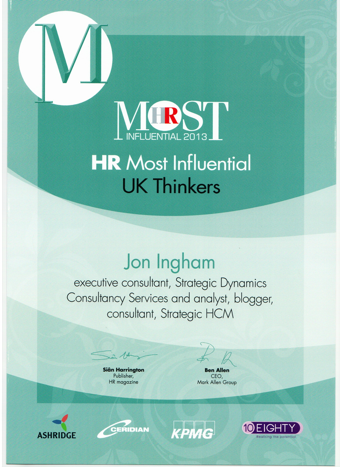
Another great evening at HR Magazine's Most Influentials last night, and I was pretty pleased to come in 7th position in the UK Thinker list.

I was especially pleased with the leap up the chart given I've not been blogging or tweeting that much recently.  So I think the recognition is largely for my consulting, training and speaking etc, rather than what I do here.

And actually I've never really had that strong a social media presence outside my blog - e.g. my Klout is currently just 55 - well below many of the social media super users and quite a few other people too!

What was interesting though is that the many of the top three in each category - UK thinkers, international thinkers and practitioners - are on social media now.  Eg the top UK thinkers are all on Twitter now:

#3 Adrian Furnham - @profAdrianFurnh (on, but now using it)

#2 Cary Cooper - ProfCaryCooper - Klout = 60

#1 Peter Cheese - Cheese_Peter - (new to Twitter and not being rated yet)


And the new Lifetime Achievers:

Will Hutton - @williamnhutton - Klout = 48

Lynda Gratton - @lyndagratton - Klout = 51


So, I'd support my previous advice that HR people wanting to be influential should be on social media.

However, I'm not sure about the rest of this advice.  I had suggested that the old guard were going to get thrown out, and thew new lot would be social mediaistas.  I don't think that's going to happen now. 

Instead, it's existing influencers who are taking to social media to extend their influence, in the way I had suggested.  And it's these influencers who are continuing to influence HR - not the social media using twitterati.

Sorry - i got this one wrong but I still believe most of the things I try to influence HR around are right!!!


Anyway, I'd like to take the opportunity to thank those HR Directors who put me on the list.  And remember, you can also recommend me on Linked too!


  • Consulting - Research - Speaking  - Training -  Writing
  • Strategy  -  Talent  -  Engagement  -  Change and OD
  • Contact  me to  create more  value for  your business
  • jon  [dot] ingham [at] strategic [dash] hcm [dot] com


Technorati Tags: , , , , , , ,

Monday, 16 September 2013

BBC and the need for people professionals first!

Screen Shot 2013-09-16 at 16.51.13.png 

As you'll have probably seen, the sorry state of the BBC's HR policies continues to make headlines (see my post on Engagement or Entwistle!) - particularly with this article in the Telegraph:


It's official: Lucy Adams has killed off the HR profession once and for all

After the BBC human resources director was accused of presiding over “corporate fraud and cronyism” over huge pay-offs to former executives, Louisa Peacock asks whether women really want to work in HR anymore? Lucy Adams could be the 'wicked witch' that changed the face of HR forever.


Lots of different reasons for the situation and subsequent reporting have been put forward, but me for, there's one that stands out above all the other factors - Lucy Adams wasn't focused on the right things - on the people the BBC employ:


Adams first learnt what she now calls one of her greatest strengths – “not being an HR person”. On walking into her first meeting as a member of the global management board her boss said: “Right Lucy, I want you to comment on finance, strategy, risk, and health and safety but don’t comment on people issues at this meeting. You are not the nice lady from personnel; you are a member of this board.”

It was brilliant advice, says Adams. “I’m first and foremost a business person. I’m a leader of an organisation who is responsible for HR, and coming at it from that angle is very helpful,” she says.


I think this business person first perspective is complete tosh, and inhibits us from making the contributions we so need to do.

I'll be talking about this tomorrow (Tuesday 17 September 2013) in this webinar organised with Halogen Software - and going out at 2.00pm BST:


HR professionals who are responsible for organizational design or development know how important it is to create the right attitudes, behaviours and ways of working rather than just focus on roles, processes and formal reporting relationships within an organization.

As HR practitioners we need to determine to what extent we (HR) want to focus on our business and our people. The prevailing thinking is that we need to become ever more focused on the business and the language of the business (e.g., finance). But if this is the direction we take, we risk losing the opportunity to demonstrate the contribution that we as HR, can make through a people-focused strategy.

In this webinar, HR consultant and author of Strategic Human Capital Management Jon Ingham, will look at why it's important for HR to focus away from finance and onto the things that will really make a difference to business performance — the people working in a business.

This session will:

  • Explore the challenges for practitioners and the profession as they determine whether they're heading in the "right" direction
  • Offer ideas and topics that are worth investigating in an effort to rebalance the HR agenda
  • Provide guidance on making a case for shifting from the current approach to a more people-based strategy


Register now!


Hope to catch you there?


  • Consulting - Research - Speaking  - Training -  Writing
  • Strategy  -  Talent  -  Engagement  -  Change and OD
  • Contact  me to  create more  value for  your business
  • jon  [dot] ingham [at] strategic [dash] hcm [dot] com


Technorati Tags: , , , ,

Tuesday, 27 August 2013

Feeling good yet? / iCIMS Recruit

img18.png 

Feeling good yet?


It’s been a long, hard slog hasn’t it, but in most of the places this blog is read, things are looking up.  The US is booming, at least in comparison to the last few years, and there’s a definite change in the air in the UK and across most of Europe.  Even in emerging markets, whilst tapering may lead to a short-term lowdown, greater global growth can only be a good thing.


Of course, this means that if you’re in recruitment or retention, you perhaps shouldn’t be feeling as good as you are!


Recruitment in particular is likely to quickly become a lot more challenging:


  • Growth and attrition mean that we’re going to have a lot more roles to fill, so continuing to get the very best people is going to be a lot more challenging.
  • Most competitors are going to be facing just the same set of challenges, so competition for these best people is going to be intense.
  • We’re going to face the full-force of employees changing expectations for the first time.  While economies were in or close to recession this wasn’t seen that powerfully but employees do now want a lot more. With a return to growth, this desire will turn into a demand.


Recruiters are going to have to be really smart to attract the best people away from  their competitors to fill the increasing number of vacancies.


Of course, the smartest recruiters have already been preparing for this situation by  modernising organisation structures, improving recruitment processes, developing capabilities and updating technologies.


For those recruitment teams still using outdated HR processes, it’s this last opportunity that probably provides the greatest return. As the recruitment world becomes more fast paced, HR professionals will have less time to get more done. Efficiency is more important than ever. That’s where technology comes in to play. Companies are seeing clear benefits from leveraging technology. But what technology should these recruiters use?


The HR technology industry is at a fork in the road: best-of-breed solutions (or solutions focused on particular aspects of HR) and full suite systems. Companies need to determine what type of system would work best for them by evaluating their business goals. Some organisations put a greater demand on HR performance. In these cases, best-of-breed systems will give Recruiters more specialised tools to improve their metrics versus standard features.


An example of a best-in-breed solution for the talent acquisition process (sourcing and recruitment to induction) is iCIMS Recruit. More and more companies are turning to systems like these to drive down those key business metrics, like cost-per-hire and time-to-fill. 


With recruitment solutions, recruiters can attract talent more easily through tools such as recruitment SEO or social media vacancy posting, helping these companies to close the vacancy sooner rather than later. But not only that, tools like iCIMS Recruit allow companies to analyse their HR programmes and pinpoint areas of improvement to facilitate hiring for the vacancy boom. 


As the economy improves, how do you expect recruiters to fill vacancies faster? 


This post is sponsored by iCIMS.


iCIMS is the leading provider of talent acquisition software for growing businesses. Through the implementation of easy-to-use, web-based solutions, the iCIMS Talent Platform helps organisations manage everything from sourcing, to recruitment, to induction all within one streamlined application.


Check out a free walk-through of the iCIMS system or make contact at +44 (0) 118 9000 706 or europeansales@icims.com.


Also see:


Social Talent Acquisition / iCIMS Connect

Technology for Induction / iCIMS Onboard


Technorati Tags: , , , , , , , , ,

Tuesday, 30 July 2013

HR Most Influential 2013

Screen Shot 2013-07-30 at 07.39.33.png  Well, it's not a result of my recent blogging - or lack of it - but I am pleased to have been included in HR Magazine's long list of Most Influentials again this year.

And yes, although I have't been blogging, I have been training, speaking, chairing and consulting more than ever before this year, all places where I think influence (at least in HR) is still most powerful.


HR Magazine want to know who from this lists you regard as influential and why. Who do you think is challenging conventional thinking, who commands the respect of peers and key stakeholders and who is bringing credibility to HR both inside and outside the business?

A panel of expert judges comprising former HR directors, headhunters and academics draws up the list based on the following criteria:-


HR Thinkers

Originality
Practical relevance
Ideas are public … written or presented (blogged as well presumably)
Challenges status quo in a positive way
Ideas are used by multiple companies
Continually refines ideas
Influential in past year


There is an HR practitioner list as well.

Please go to http://www.hrmostinfluential.com for most details and a link to complete the survey.


  • Consulting - Research - Speaking  - Training -  Writing
  • Strategy  -  Talent  -  Engagement  -  Change and OD
  • Contact  me to  create more  value for  your business
  • jon  [dot] ingham [at] strategic [dash] hcm [dot] com


Technorati Tags: , , ,

Wednesday, 26 June 2013

#DebateHR: HR Raging Debates - please comment!

raging_promo_badge_250x250.png  I'm included as one of the 'experts in Halogen Software's latest round of HR Raging Debates, describing my views on:


Talent shortage - "In most businesses it's the team & community which provide performance, not just individuals."

Managing generations - "What we really need to do is to treat each individual, not just each generation, differently."

Corporate culture - "Culture isn’t just limited to executing strategy, it IS the strategy.

HR analytics - "I think there’s more nonsense written about HR analytics than any other topic in HR."


Other contributions are from China GormanHenryk Krajewski, Trish McFarlaneJon Ingham, Heather BussingDominique Jones Laurie Bassi and Robin Schooling.

As you may know, I'm not a great supporter of this idea about experts and hence, non-experts, and it's a shame that your comments on our comments have to packed into a tiny space on page 9.  (I'd much rather everyone has an equal chance to debate.)  Nevertheless, a comment is much better than no comment at all!, so please do!

See you over there!


  • Consulting - Research - Speaking  - Training -  Writing
  • Strategy  -  Talent  -  Engagement  -  Change and OD
  • Contact  me to  create more  value for  your business
  • jon  [dot] ingham [at] strategic [dash] hcm [dot] com


Technorati Tags: ,

Monday, 24 June 2013

#SHRM13 Why Your Talent aren't Talent

IMG_0318.JPG  I was in Chicago last week presenting on 'The New HR' at SHRM's Annual Conference in Chicago.

There were some great sessions going on, and it was wonderful to catch up with and meet lots of great HR people too, though I ended up working in my hotel room more than I'd wanted.

Key reflections:

  • It was big.  No, like really, really big!  (the biggest SHRM conference ever in fact with some 16,000 attendees.  I've got to get me on that main stage!
  • There was a lot more use of social media than at CIPD, and plenty of more powerful social events too.
  • I personally though there was an overkill of stuff on SHRM in the introductions before the main speakers.  That also made it feel very different to the CIPD's conferences, and not really in a good way.
  • Chicago still brings back memories of visiting on short escapes from 'Hard Code' COBOL programming school in St Charles.  I'm glad I made the shift over to HR.


IMG_0339.JPG  My favourite session, other than Hilary Clinton's keynote, was with David Rock speaking about talent and neuroscience.


So our talent often aren't talent because they're just the people who shout the loudest.  I made a similar case in my session - that we're much better at identifying talent who contribute through their own capability and engagement (i.e. from a human capital perspective) than we are at finding talent who create value through their support and impact on other people (a social capital one).


I'll also be attending, blogging and tweeting on David's EMEA NeuroLeadership Summit in September. Mind you, David also suggesting tweeting (and any multi-tasking) makes us less smart.  I'll have to try to avoid that happening to stay up with what I'm sure will be some great content! 


  • Consulting - Research - Speaking  - Training -  Writing
  • Strategy  -  Talent  -  Engagement  -  Change and OD
  • Contact  me to  create more  value for  your business
  • jon  [dot] ingham [at] strategic [dash] hcm [dot] com

.

Friday, 7 June 2013

In Sensual Company

Screen Shot 2013-04-11 at 22.22.31.png  As well as Dave Ulrich, my other co-presenter in South America has been Jesus Vega de la Falla, former HRD at Inditex (Zara etc) and author of The Sensual Company in which he writes about how other companies can generate similar passion to Zara in their employees:

"What is Zara so that millions of people take to the streets every day with his clothes?  What does Google for tens of thousands of people respond to a selection process? Why some companies are desired and indifferent to other investors, customers or employees? Do you have to be handsome and powerful to be attractive?

We speak of a new power, that of those companies who pursue their appeal, they have managed to seem to be interesting and through very different actions, but with one common factor: the exercise of seduction, as a business strategy. Your successful guarantee. The company is the opportunity sensuous know what makes it desirable for a company to woo people as diverse as employees, customers or investment groups …"


Zara sounds like a very special (maverick) company - one in which there is real love for the company.  And I've written about love here several times before, and have just about got over my hangups about whether love is something we should strive for at work.  It is.  But now I've got a whole new paradigm to shift because for Jesus the opportunity is not just about love (ongoing comfortable love between a man and his wife, or even the ongoing conflict between two people who can't get on but can't do without each other either) but real, intense, sensual and passionate love between two lovers.  Ahem.  That's the first time I've written about this here!

But that's the sort of love Zara wants to create in its customers and it knows it can only do that if its employees feel intense love for its employees.  Blimey!


I talked about this with Jesus sharing a taxi from Bogata Sheraton to the airport.  But actually in his presentations he's been talking about something slightly different - the need to know ourselves.  To be able to overcome our own egos and become the people we have the potential to be.  Because it's only when we have this knowledge of ourselves that we can start to create deeper relationships with other people.  I've written about this here too - though again in rather less passionate language.  So I've suggested that we need to develop human capital - through organisations which values each employee, and helps each employee value themselves, before we can develop social capital - in which employees truly value each other.

But creating intensity and passion does sound better doesn't it!


  • Consulting - Research - Speaking  - Training -  Writing
  • Strategy  -  Talent  -  Engagement  -  Change and OD
  • Contact  me to  create more  value for  your business
  • jon  [dot] ingham [at] strategic [dash] hcm [dot] com

.

Technorati Tags: , , , , , , , , ,

Wednesday, 5 June 2013

Presenting with Dave Ulrich and Insights on Behaviour and Change

DSCN5240.JPG  I'm in Bogota, Colombia presenting later on after Dave Ulrich (he's my warm-up today and I'm returning the favour in Chile on Friday.)

There have been loads of great insights as usual, but I particularly like this one - that influencing someone to change, eg transforming the perception of HR, is about providing information, changing behaviour and reinforcement.

Changing behaviour is an interesting one - the idea is that by making someone behave as if they believed something they become more as if they believed it.  For example, one of the best ways to retain high performers is to involve them in recruiting new employees.  By getting them to behave as if they are committed makes them more committed.  I quite like that.


It's not that new of course and has been one of the most prevalent aspects of change management over the last 20 years.  The theory used to be that we should change peoples' attitudes because that would have deeper impact on them than simply changing the behaviour.  But about 20 years ago we started to understand this was just too much hard work and that changing behaviour was often the best we could do to change peoples' attitudes.

I thought Jamie Duck summed it up quite well in the Change Monster:

"According to conventional wisdom, change works like this: You start by getting people to buy into a new corporate vision, thereby changing the attitudes.  They will then automatically change their behaviour, which will result in improved corporate performance.  After seeing this improvement, they will confirm their commitment to the corporate change programme, and the success spiral will continue.

Unfortunately, it’s not realistic to expect that kind of response in most companies these days.  By now, the troops have been through so many of these programmes that they’re sceptical.  Companies today are full of ‘change survivors’, cynical people who’ve learned how to live through change programmes without really changing at all.  The new programme is just another management fad in an endless series of management fads.

In most companies, the real context for change is exactly the opposite.  Top management should start by requiring a change of behaviour, and when that yields improved performance, the excitement and belief will follow."


But I wonder if we're starting to progress beyond this again now though.  People are now much less receptive to being asked to do things they don't agree with or believe in.  Doing this has the potential to reinforce the individual's existing perspectives, and increase cynicism about the organisation too.

But I still thought the example was quite neat.


Anyway, that will do for today's session.  I would share more but Dave keeps saying he hopes his most interesting stories don't show up in the media, and I think he's talking about me.


  • Consulting - Research - Speaking  - Training -  Writing
  • Strategy  -  Talent  -  Engagement  -  Change and OD
  • Contact  me to  create more  value for  your business
  • jon  [dot] ingham [at] strategic [dash] hcm [dot] com

.

Technorati Tags: , , , , , , ,