Saturday, 27 April 2013

Brave HR / 2

Screen Shot 2013-04-26 at 22.42.23.png  I'll also be speaking about brave HR in Eversheds' HR Summer School at Oxford University this Summer:


HR Confidence: Value Creation from our People Focus

We hear a lot about HR needing to be business people first, HR people second, but often HR creates more value by being different rather than the same. For example, finance’s focus on efficiency is strengthened when combined with HR’s advocacy of alignment and engagement – particularly when it comes to attracting and retaining next generation talent. John will illustrate the importance of remaining people focused post-Ulrich.


Maybe see you there?


  • Consulting - Research - Speaking  - Training -  Writing
  • Strategy  -  Talent  -  Engagement  -  Change and OD
  • Contact  me to  create more  value for  your business
  • jon  [dot] ingham [at] strategic [dash] hcm [dot] com

.


Technorati Tags: , , ,

Friday, 26 April 2013

Brave HR

Screen Shot 2013-04-26 at 20.28.54.png  This Summer's ConnectingHR unconference focuses on Brave HR.  So what is brave HR?


Today, one of the ConnectingHR community members and organisers of the unconference, Graham Frost, started a twitter conversation on what we think this thing is.  For me, three different things came to mind.

The first of these is challenging our businesses when they do stupid things.  Trust in business is at an all time low (down to 38% of people in Edelman's Trust Barometer UK results).  And employee engagement is down as well (35% in the CIPD's Engagement Index in their last Employee Outlook).  This isn't our employees fault.  Every time a business defrauds its customers or investors (by needlessly giving their money to its CEOs); every time it finds a way round regulation or avoids paying appropriate taxes; every time it colludes with its competitors; every time it contaminates our environment; every time it treats its employees as dispensable assets, it turns people off business.  That's business in general and this business in particular.  And it needs to stop.  HR can and should play a role and possibly a leading role in this.  The tendency however is to collude with other business leaders and we need to be braver to speak out.


Screen Shot 2013-04-26 at 20.40.52.png


Also see:


The second aspect of brave HR is not being confined by a business agenda.  We're becoming so conditioned by the need to support the business but we can often create more impact by making our businesses better fit for our people than we can be aligning the people with our businesses.  It may not make us popular to say this but for me it needs saying...


Screen Shot 2013-04-26 at 20.57.46.png


Also see:


This then led me onto thinking about what I think is the best articulation I've seen recently of how businesses as a whole need to change.  This is from John Mackey at Whole Foods Stores in his presentation at the Concious Capitalism conference this year.

Mackey talks about How businesses need to do more than earn money in the same way that other professions such as teachers and doctors aren't just focused on what they do to earn money.  And I wonder is this should be the case for HR?  It's certainly true, linked to my first point above, that we should encourage a more conscious approach in the businesses we work within.

But linked to my second point, should our profession focus on more than just helping business?  In an individual organisation, probably not - we need to focus on helping that organisation do whatever it is attempting, though we can certainly encourage a long-term perspective to this eg investing in local communities because otherwise the business eventually won't have any communities to operate within.

But as a profession, there's certainly an opportunity for us to be concerned about things like tackling youth unemployment; meeting future skill needs; providing compelling work and careers; and developing greater social mobility more than we are.  I think this would be brave HR as well.


Also see:


Want to know more?  Come to the Unconference!  You can also join the ConnectingHR community at connectinghr.org.


  • Consulting - Research - Speaking  - Training -  Writing
  • Strategy  -  Talent  -  Engagement  -  Change and OD
  • Contact  me to  create more  value for  your business
  • jon  [dot] ingham [at] strategic [dash] hcm [dot] com

.

Technorati Tags: , ,

Monday, 22 April 2013

What is Social HR?

Screen Shot 2013-04-22 at 09.25.46.png  I'm not normally very good at remembering to send posts to HR Carnivals, but this month this is being done by Anita Lettink who I think generates some very interesting ideas for HR, so it's one that I particularly wanted to enter into.  Oh, and it's on Social HR, which is also where I seem to be spending most of my time these days.Anita says the carnival was triggered by a post from Paul Taylor at Bromford on 'how social is your CEO?' and has therefore invited contributions on 'how social is your HR?'.


I'd like to deal with he social CEO first.  This is something I've spoken about previously and I also linked to another recent post on the subject in the Social HR community:

Screen Shot 2013-04-22 at 09.22.54.png


For me, the key issue isn't whether your CEO is on social media.  They may want to be, they may not. The choice depends on a lot of things including them and their priorities and the culture of the business, etc (I think Paul expresses it very well too).

And OK, it's not going to help if they ignore their social tools completely but I don't think they need to feel that they should be using them extensively.  Now they do need to connect with their employees, and they probably need to be quite 'social' to do this.  But the biggest issue for me, and I believe for lots of people these days, isn't whether a CEO is using social media.  The big issue generally today is their reward.

If a CEO is on 354 times the average employee they're simply not going to connect with other employees.  They can tweet all they like but they're just not going to be able to connect.  It's why I thought Lord Wolfson's actions last week to distribute his £2m bonus to Next's employees was such a great thing to do.  Now he's a social CEO.

Screen Shot 2013-04-22 at 09.09.01.png


That then leads us onto social HR.  And this, again, I don't think is just or mainly about social media.  And although there will be exceptions for most HR Directors social HR isn't going to be about the size of their own rewards.  Instead it's about how they're injecting social approaches, and looking for social outcomes, in their people management and organisation development work.

If you want to understand more about what social HR looks like - and that includes the broader 'being social' elements as well as the use of social media, for each process in the employee lifecycle, and beyond, they stay tuned in the Social HR community as I'm going to encourage some discussions on each of these processes there.


However, there is another difference between the CEO and HR.  Some of social HR is normally going to be informed through the use of social media.  It's also the newest element of social HR for many people and organisations.  It's one that can go badly wrong if mis-handled.  And it's the area where there is the greatest and fastest change.  HR does need to understand and sponsor social media.

For a CEO I don't think this is that important.  For HR, it is.  We need to be using social media ourselves, as practitioners and as functions.  And we need to be using it socially - for connection.  And we need to be using it where appropriate to support our HR processes too.

But the key thing is that we need to be using it ourselves - as this will help us understand these technologies' opportunities and limitations.


There you go.  Oh, and I know I've not really addressed Anita's question about assessing how social your HR is.  But before we can assess this we need to understand what we're measuring ourselves against.  And I hope I've explained why, for me, this is about being social, and perhaps using and understanding social media ourselves, and not just about incorporating social technologies into HR.  That's why the HR Carnival remains important and relevant too.


  • Consulting - Research - Speaking - Training - Writing
  • Strategy - Talent -  Engagement -  Change and OD
  • Contact me to create more value for your business
  • jon [dot] ingham [at] strategic [dash] hcm [dot] com


Technorati Tags: , ,

Tuesday, 16 April 2013

#SEEngage #E4S: Tailoring the Engagement Survey

Screen Shot 2013-04-16 at 23.31.45.png  I mentioned in yesterday's Engage for Success radio show that I was looking forward to today's Employee Engagement Summit with Symposium Events.

It's been a varied conference with quite a bit of input from Engage for Success (David Macleod and Nita Clarke presenting once again), quite a bit on values and a fair amount on surveys.  For example Geoffrey Matthews who has just written a book on engagement with Linda Holbeche, 'Engaged' presented 10 warning signs to avoid engagement surveys being a bottleneck vs breakthrough.  You can see these described in an article at HR Review, managed by the Symposium people.

I don't disagree with any of these 10 points but I still think it's the design of engagement surveys which is key.  That's particularly the case as it becomes easier to understand engagement levels on an ongoing basis through semantic analysis of enterprise social network conversations, or through simple mobile tools like Joel Cheesman's Morale.Me, or other oil technologies like Thymo Metrics (I came across today).

I've already blogged quite a bit on formal engagement surveys and suggested the most important requirement (which I think becomes more important as other informal tools become more popular) is the linking of satisfaction and engagement, i.e. activity and outcome.  However I've also suggested that we should actually broaden out from engagement into other areas of organisational capability, e.g. things like confidence too.

Increasingly however, I've become convinced that a major key to engagement, and therefore to engagement surveys too, is to tailor the outcomes i.e. the type of engagement we're asking about to the specific capabilities of the organisation.  I posted about the importance of this in terms of raising engagement yesterday (point #2) but didn't develop the argument through to discussing engagement surveys.

It means that if a company's key capability is about innovation, it's outcome questions about engagement need to include the standard stuff about retention and advocacy but should also focus in on generation of ideas, participation in innovation processes, quality of weak ties etc.  If the capability is about speed of execution, the engagement questions should focus on speed of response, flexibility, focus on priorities etc.

To me, it's this tailoring of engagement surveys which is, or should be, our greatest priority currently (in terms of survey.  And I do agree with Geoffrey that it's what comes after the survey that's important.  But a well designed, insightful survey starts those actions off much more effectively than can otherwise be the case.)


  • Consulting - Research - Speaking - Training - Writing
  • Strategy - Talent -  Engagement -  Change and OD
  • Contact me to create more value for your business
  • jon [dot] ingham [at] strategic [dash] hcm [dot] com


Technorati Tags: , ,

Wednesday, 10 April 2013

The Economist's Talent Management Summit and the new rules of Employee Engagement


Screen Shot 2013-04-11 at 23.55.22.png  One of my favourite conferences is the Economist's talent management summit which I spoke at last year and this blog has been supporting for three years now (see my competition to attend and blog for me at this year's event).

As usual this year there'll be the normal range of great quality sessions.  For example, one I'd be keen to see is Data and Smarter Decision-Making: Making Analytics Work for Your Business featuring Marlon Sullivan from Abbott Laboratories and Matthew Jeffery now at SAP.  That's partly because Matthew is always such good value but mainly because I think the link to decision making is the common missing link in the big data agenda.  Data analysis is only useful if it informs better decision making and I think we often forget this fact.

But I thought I'd post on one of the other sessions which is with Jean Martin from CEB on the New Rules of Engagement.  That's partly because it's a topic I've been presenting on myself recently and have been meaning to post on for some time.  So I don't know what Jean will say, but for me the new rules (I'd prefer guidelines) are about:


1.   Prioritising engagement - understanding that it's important, and will continue to increase in importance, as more and more organisations compete on their culture / organisational capability and which needs to include at least an element of engagement.

2.   Investing in engagement - acknowledging that engagement is difficult to achieve as although there are simple things which can be done, they're mostly not simple things to do on a continual basis.  And also because not all of these things are simple anyway.  Engagement should always be engagement to do certain things (engagement in innovation needs to look different to engagement in speed or efficiency) and understanding, articulating and building an environment around these specific connections generally isn't that easy to do.

These first two 'rules' aren't necessarily that new, but they are certainly now more of a requirement.  Whilst engagement was a new and less important concept it was probably enough just to focus on doing the basic management essentials well. That's no longer enough today.  We need to understand much more clearly what engagement needs to look like within our own particular organisations, and see developing what's required as a key strategic requirement too.


3.   Making engagement more human.  We used to be able to ask for peoples' engagement simply to support business needs, or because of our hierarchical position of authority.  That doesn't work these days.  Instead of this, we need to focus on developing personal relationships as the basis for engagement.  People will increasingly engage in supporting us if they want to support us as individuals - not just because they want to achieve certain business needs.  This shift is making the belief that managers lie at the centre of engagement ('people join organisations but leave managers') even less true.

4.   Accepting challenge is engagement.  Another change has been in moving away from wanting everyone to line up behind us.  This never worked that well anyway.  But increasingly asking for this unthinking compliance just turns people off.  Employees may still keep quite and line up, though increasingly they won't (they'll just blog about you instead).  What works these days is to present arguments, have conversations and to try and bring people on board.  But if people still don't agree then we need to accept this.  This challenge and conflict is still engagement (it's the silent cynical compliance which is non engaged).  This doesn't stop us having people working to the same plan, but it certainly alters the dynamics involved in getting to this.

By the way, I think a really good example of what I'm writing about here comes through from the government's actions in the NHS post the Mid Staffs debacle and in particular the banning of gagging clauses to silence whistle blowers.  Take this quote from Health Secretary Jeremy Hunt:

 "There has been a culture where people felt if you speak up about problems in the NHS you didn't love the NHS. Actually it's exactly the opposite.


Criticism is positive you see - but I don't think that's the way we tend to think about engagement now.  So I do think these last two 'rules' are new, and it'll be interesting to see whether they come up at the Economist's event.  Are there any other 'rules' that you'd add, or do you agree / disagree with mine?  

Hopefully we'll get some input here from Jean's presentation at the Talent Management summit too...


  • Consulting - Research - Speaking - Training - Writing
  • Strategy - Talent -  Engagement -  Change and OD
  • Contact me to create more value for your business
  • jon [dot] ingham [at] strategic [dash] hcm [dot] com


Technorati Tags: , , , , , , ,


#HCSummit - virtual learning at Avon Products


Screen Shot 2013-04-09 at 19.33.41.png  I'm virtually attending another of HCI's annual summits.  We've had sessions from Dan Pink and Liz Wiseman and leading practitioners such as Colleen McCreary at Zynga.

My favourite session however has been from Andrea Procaccino, Global Director of Learning and Development at Avon Products, focusing on innovative learning delivery, particularly virtual and social communities.

Out of these areas it's been the virtual aspect that I've found most interesting, and I also found rather surreal - since I have been engaged in virtual learning myself.

So we're talking about immersive, 3D learning environments featuring virtual offices or meeting rooms with multiple interactive displays for people using avatars to work, collaborate and learn together.  These environments have webcams, VOIP, videoconferencing and text chat features but more importantly the ability to present social cues (Andrea talked about a session she'd been running where someone took a look at their watch to let her know to move on).

The first big player one virtual worlds, Second Life, are still operating in this pace but Avon use and prefer Proton Media's systems.  They use these in a range of areas but sales training seemed to be a key one.  Andrea talked about a scenario to help sales people listen to what others told them featuring a guy reading a fishing magazine which led onto a conversation about bugs and provided an opportunity to introduce Avon's skin products.

I liked the session because we are no seeing a lot of companies focusing on social, mobile, gamification etc - all of which Andrea talked about too.  But there are a lot of other opportunities too.

Andrea mentioned the importance of all these tools for the younger generation which I thought were a bit overblown.  But I do support Andrea's points about the challenges involved in getting engagement in these different ways of doing learning / HR.  It took them one year to introduce their new approach, but the major challenge and time requirement within this change was getting leaders to understand that it's OK for people to have fun!

Anyway, the HCI virtual learning experience hasn't been quite so as advanced - I've had no avatar for example - but it's still been great to attend the conference without having to hop across the pond.


  • Consulting - Research - Speaking - Training - Writing
  • Strategy - Talent - Engagement - Change and OD
  • Contact me to create more value for your business
  • jon [dot] ingham [at] strategic [dash] hcm [dot] com


Technorati Tags: , , , , , ,


Saturday, 30 March 2013

Cloud, big data and social media transforming HR

Screen Shot 2013-04-11 at 23.25.57.png  I only recently came across this interview in Computer Weekly that I provided during HR Tech Europe's Spring Warm-Up.  I talk about the need for HR and IT to work more closely together and then go on to say:

"In most UK organisations, the technology used to underpin HR operations is "woefully inadequate" compared to level of IT used in the rest of the business, Ingham said.

“What you have is a huge gap between what organisations are doing and what they could be doing, in one of the areas that is becoming the most important for business,” he said.

Ingham advised HR professionals start learning about the impact that social analytics, cloud and other technical innovations could have in driving the effectiveness of business."


The first paragraph sounds a bit stronger than I really believe but I did mean what I said about the gap.  And we do need to get much more closely connected to the developments in HR tech...


  • Consulting - Research - Speaking - Training - Writing
  • Strategy - Talent -  Engagement -  Change and OD
  • Contact me to create more value for your business
  • jon [dot] ingham [at] strategic [dash] hcm [dot] com


Technorati Tags: , , , , ,

Tuesday, 26 March 2013

Social Talent Acquisition


Screen Shot 2013-03-22 at 17.58.23.png  Probably the best example of social talent management exists in recruiting.  I think there’s a good few reasons for this, including that:

  • Recruiting is fairly process oriented, with an extensive adoption of traditional technology use
  • It is often one of the least well executed areas of HR (see my post on the candidate experience) so has the most potential for improvement
  • It’s externally oriented and therefore more impacted by the general uptake of social media outside business, which is generally ahead of uptake within organisations
  • There’s also more opportunity for external stakeholders ie candidates to make more of a fuss than internal ones ie employees when things don’t go well.


In my presentation at the Enterprise 2.0 Summit I referred to Glassdoor and the impact this and other sites having in forcing companies to get their act together here.  I know a lot of readers know about this site, the ‘TripAdvisor of recruitment and employment’, but an awful lot of recruiters still don’t.


But I know from my trips to the States that many people are now looking here before they have a look at a company’s career site.  And that if they do decide to apply they’ll look in Glassdoor for information on roles, salaries and the employment experience.  And that if they get an interview, they’ll look on the site for information about tests and questions etc.  I also know that when I search on US based HR people, the top entry which comes up is increasingly an entry about them on Glassdoor (and it’s often not that nice).  We will increasingly see the same thing in the UK, Europe and beyond.


A lot of people dismiss all this as just something that’s going to happen and that people with gripes always comment more than people with good feedback.  And that’s true, but the ratings are still pretty valid (see Lauri Bassi’s book, Good Company) which is why candidates feel able to rely on them.


Zwi Segal also shared some similar if less comprehensive data on this as part of his presentation, again confirming that there is a link between Glassdoor ratings and company performance.


photo-4.jpg


It’s because of these factors that I think more recruiters than in other areas of HR realise they need to move to a more social approach, combining traditional recruiting technologies with the use of social media.  But even in recruiting, a lot of the use of social media isn’t very social.  Sure we can use Linkedin and other tools to advertise our jobs.  But we also need to change our approaches to be more social, helping us connect and communicate with our candidates in a way that we’ve not had the need or the ability to do before.


There are really just two key needs which I can demonstrate using iCIMS Connect product (I’ll also explore iCIMS’ social jobs distribution tools at a later date).


Firstly, you need an ability for candidates to connect with you without having to apply for a specific job.  Doing this also helps avoid the high applicant to hire ratios which do nothing for employer branding or the ability to make sensible recruitment decisions.  iCIMS support this through their Social Connect Portal: with as little as one click candidates can share their social media profile to subscribe to recruitment communications and be informed of new positions that meet their interests.


Secondly, you need an ability to connect and easily communicate with your candidates on a regular basis.  iCIMS’ email tool allows you to create Talent Pools of candidates by function (e.g., Sales, Engineering, G&A) and to personalise the experience based on hiring needs, available talent and business activity.


Screen Shot 2013-03-22 at 17.50.27.png


So the technology is there, but you do also need a mindset which gives the candidate much more attention and focus than we’ve often applied to them in the past.


This post is sponsored by iCIMS.


iCIMS is the leading provider of talent acquisition software for growing businesses. Through the implementation of easy-to-use, web-based solutions, the iCIMS Talent Platform helps organisations manage everything from sourcing, to recruitment, to induction all within one streamlined application.


Check out a free walk-through of the iCIMS system or make contact at +44 (0) 118 9000 706 or europeansales@icims.com.


  • Consulting - Research - Speaking - Training - Writing
  • Strategy - Talent - Engagement - Change and OD
  • Contact me to create more value for your business
  • jon [dot] ingham [at] strategic [dash] hcm [dot] com


Technorati Tags: , , , , ,

Monday, 25 March 2013

#E20S Social Talent Management


Screen Shot 2013-03-22 at 16.46.49.png  My own session at the Enterprise 2.0 Summit was on Social Talent Management.  Unfortunately attendance wasn’t great so I’m going to post here covering the key points of my presentation.
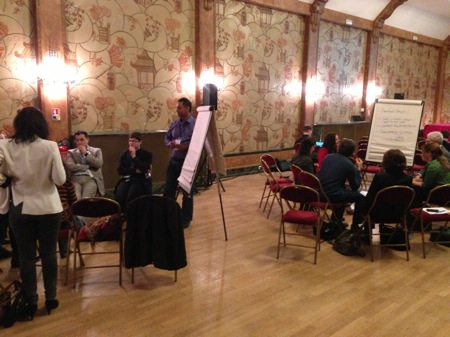

I was asked to talk about the evolution of talent management and I wanted to start by pushing back against the common tendency, which seems particularly strong in Enterprise 2.0 circles, to present roadmaps and journeys that all organisations are or should be on.  I don't believe this is true in general and it's certainly not the case for talent management.  There are many different approaches in talent management, and many different directions of travel going on at once as well.


To the extent that there are common trends, the use of social media is certainly one.  But I still don't think this means talent management has become particularly social.  I took people through Gary Hame's thoughts on management 2.0, which should really apply to the whole of Enterprise 2.0 too, but I think they have, or should have, particular resonance for talent management 2.0 as well.


But there's not much going on in talent management that demonstrates Hamel's principles:

  • Everyone has a voice
  • Capability counts for more than credentials and titles
  • Commitment is voluntary
  • Power is granted from below
  • Authority is fluid and contingent on value-added
  • The only hierarchies are ‘natural’ hierarchies
  • Communities are self-defining
  • Individuals are richly empowered with information
  • Just about everything is decentralised
  • Ideas compete on an equal footing
  • It's easy for buyers and sellers to find each other
  • Resources are free to follow opportunities
  • Decisions are peer-based.

So the good news is that there are things happening in just about every sub-process of talent management, except for, in the main, reward.  We'll be discussing all of these over the next year at the Google Plus Social HR community, so if you're interested in finding out more, join us there too.


  • Consulting - Research - Speaking - Training - Writing
  • Strategy - Talent - Engagement - Change and OD
  • Contact me to create more value for your business
  • jon [dot] ingham [at] strategic [dash] hcm [dot] com

. 

Technorati Tags: , , ,

Thursday, 21 March 2013

#E20S Management Hackathon


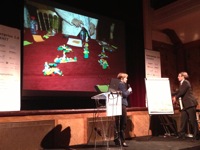
photo-11.jpg We've been running a short hackathon process looking at innovating management within a social / enterprise 2.0 business.  We were takes to identify principles that would underpin action in the organisation.
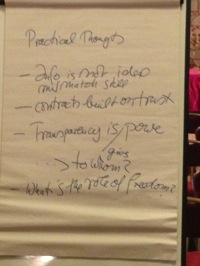
Here are some of the outputs:


photo-7.jpg  Organisation #1

  • Exponential organisation - able to grow quickly
  • Network organisation
  • Fractal organisation - hierarchies within hierarchies
  • Based on diversity supported by flexible working
  • A bit like a club, enabling everyone to follow their own needs
  • Always thinking about the customer
  • Based on social media and big data
  • Transparent


photo-4.jpg 

photo-2.jpg  Organisation #2

  • Traditional core of the organisation
  • Fractal and pod ideas from Dave Gray
  • Enabling both project based and continual operation type work
  • Enabling people to move around or doing the same thing
  • Managers acting as sponsors for a project
  • Processes for rotation between projects
  • Tenure limits to stay in the core (don't want people to stay as the boss)
  • Fail forward - encourage people to fail - pay them for their failures
  • Accountability in the core and the pods
  • Self regulation


photo-6.jpg  Leadership #1

  • Different to management (fossilised leadership and management is no longer necessary)
  • Distributed - everyone is a leader
  • Empowered to decide and act
  • Listening
  • Emerging, recognised as a leader for their charisma, not appointed
  • A feeling, a way to do things
  • Introverts as well as extroverts
  • Able to handle fear, supporting failure
  • Being inclusive, comfortable with difference, leveraging diversity
  • Developing and using collective intelligence
  • Alternative = authentic, honest and transparent
  • Chasing their own passions
  • Embracing change so fluid and transient
  • Remaining open question on whether we still need leaders or even a CEO


photo-8.jpg  Leadership #2

  • The why of the organisation (management is the how - empowering and developing people)
  • Walking the talk in order to be credible
  • Driving soft and social skills
  • Supporting complexity
  • Being able to be challenged against an environment of constant change
  • Experimenting on the edge.


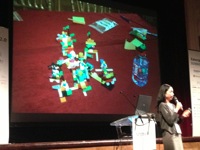
There were also two groups using lego.


photo-9.jpg  Lego 1:

  • People with good networks
  • Open flexible structure - based on creativity
  • A clear vision of where we want to go
  • Open, agile minds looking into the future
  • Bringing the whole organisation together
  • People on top


photo-10.jpg  Lego 2 with an image of an airport:

  • Users in a plane trying to take off
  • Empowered by ingredients, enablers and values of respect
  • And some leaders
  • The wind of serendipity
  • Growing motivated people
  • A bridge to bring people together
  • An airport tower with complete view of the whole organisation


I wouldn't support all of these points but we did better than I thought we would.  But I thought we could have done with more structure, some pre-formed relationships, and clarity in what we were trying to develop (I still don't think we're all sure / agree what social / 2.0 is - see the above point on 'users'!).

I really liked the team presentations that demonstrated some of these points, e.g. the teams that gave themselves a name, supporting these relationships (the age experimenters, and the change eggperts as they had trouble deciding between the chicken and the egg).  And the teams that worked in the the style of the organisation e.g. demonstrating distributed leadership with full team presenting together.


  • Consulting - Research - Speaking - Training - Writing
  • Strategy - Talent - Engagement - Change and OD
  • Contact me to create more value for your business
  • jon [dot] ingham [at] strategic [dash] hcm [dot] com

.