Monday, 31 March 2014

HR Days - Adageology and why People Leave People


I've been out in Croatia at a conference called HR Days organised by Moj Posao.

My presentation was on a topic which had been occupying me since TENEO's conference earlier this month, where I'd seen a couple of inputs challenging the common adage that people join organisations but leave managers.


It's also a perception that I've long argued against (see 1 and 2).

So I talked in my session about adageology - the tendency to build systems on principles which are completely unsound.  And it's one reason why measurement is important, but I still don't think we need big data (as in the IBM Kenexa report which Clodagh refers to in the tweet above) to tell us the adage is wrong.  It's clear from a strategic perspective and understanding about what's happening in society that people don't look up to authority in the way we used to, ie the death of deference.  So why should we still see managers as so important that retention is all about them?


It looks to me as if the case is now closed - but I've still come across a couple of people trotting out the same old adage just over the last couple of days, so maybe not after all?


By the way, my next trip to Croatia will be for a new global HR conference, Art of HR taking place in November - I hope you might join me there!


  • Consulting - Research - Speaking - Training - Writing
  • Strategy - Talent - Engagement - Change and OD
  • Contact me to create more value for your business
  • jon [dot] ingham [at] strategic [dash] hcm [dot] com
.


Monday, 24 March 2014

TENEO #HRCoreLab2 Performance Management


Earlier this month I co-chaired Teneo's 2 day Performance Management conference as part of HR Core Lab 2 in Barcelona.

It was a great event, as always with TENEO, though I felt we'd failed to really get to grips with the big issues on performance management ie there were quite a few sessions from companies which were in the process of transforming performance management, and a couple from some which were thinking of doing so, but no real evidence of a completely successful change.  Indeed, quite a few of the presenters seemed quite happy with their existing, traditional approaches.

And yet, I think that most people agreed, and as Jerome Sulivan from SuccessFactors suggested, everyone hates performance management.  If this is the case, we surely need to start doing something more radicallly different from how performance management exists today.

It was also interesting that during the two days of the conference, Josh Bersin by Deloitte was also commenting on performance, based on the firm's global human capital trends survey:


But I thought the best evidence against performance management was provided by Jerome, though I think his view was that it supports rather than opposes the case.  63% of higher performing businesses use performance management, and only 22% of lower performing businesses do the same.  But this doesn't mean using performance management helps.  To me, it suggests that even lower performers, which need to improve their performance most, don't see the value in performance management in helping them achieve the improvements they need.


I suggested that one solution is a focus on social performance management - firstly because the team provides a better level of focus for much of HR, and particularly performance management, than the individual; secondly because it can also be a more meaningful way to develop and reward the individual; and thirdly, and most importantly, because by making it social it becomes part of the culture and this makes it more sustainable (ie people will / have to talk about team performance in a way they won't do when it focuses on the individual.)

So I liked Alberto Platz' description of the way that Swarovski has anchored performance management in the culture of their business:


Other good ideas included:
  • Genevieve Guinot from CERN's suggestion that performance management needs to encourage both competition and co-operation or co-opetition, supported by cross fertilisation, excellence as an overarching value, collaborative decision making and a long term focus.
  • Wouter Van Linden from KPMG's description of the value of moving away from forced distribution and a complex 9 box grid to a guided distribution based on a simple 5 point linear rating.
  • Christoph Williams from Sony's use of an internal Net Promoter Score / NPS and Klaus Bodel from BMW's experience of using a balanced scorecard as the basis for training measurement (but note I don't believe Kaplan and Norton's standard perspectives work for HR - see http://www.slideshare.net/joningham/the-hr-scorecard.)
  • Fiona Whitworth from Rio Tinto's encouragement to align the approach to performance management with the context of the business unit and employee population etc.
     
I also liked the discussion from Peter Sale at Nokia Siemens Networks about aligning performance management changes with the context and culture of the organisation.  For example, they are currently considering one of:

  • Continue Current +
    • Build on Experience

    • Further enhancement
  • A Holistic Model
    • Broad labeling on talent/performance scenarios rather than ratings
    • 
Performance discussion occurs in a broader way

    • Calibration discussions still ensure consistency of criteria and feedback
    • Distribution curve for talent only
  • No Rating
    • Focus on continuous dialog and broader discussions on performance 
    • A minimum of two formal dialog sessions a year, 
    • Calibration still occurs but is a basis for broader discussions on performance 
    • Talent management and succession planning follows existing approach

What transformations are you planning in your own business?


  • Consulting - Research - Speaking - Training - Writing
  • Strategy - Talent - Engagement - Change and OD
  • Contact me to create more value for your business
  • jon [dot] ingham [at] strategic [dash] hcm [dot] com
 

Saturday, 15 February 2014

HR Technology Key Trends 2014


You might be interested in these comments from me and others on the key trends in HR technology currently - published by HRZone.

My remarks are on data analytics - I'm not convinced!


  • Consulting - Research - Speaking - Training - Writing
  • Strategy - Talent - Engagement - Change and OD
  • Contact me to create more value for your business
  • jon [dot] ingham [at] strategic [dash] hcm [dot] com


Thursday, 30 January 2014

People Focused People Management Strategy


I also did this webinar for Halogen Software - on wht we need a people focused, not simply a business focused, people management strategy.

See the slides and this blog post.


  • Consulting - Research - Speaking - Training - Writing
  • Strategy - Talent - Engagement - Change and OD
  • Contact me to create more value for your business
  • jon [dot] ingham [at] strategic [dash] hcm [dot] com


Wednesday, 15 January 2014

#20mmc : HR & Technology - A Relationship that Can't be Broken!


I've not got around previously to sharing the archive of a short webinar I did recently with SuccessFactors - 20 Minute Masterclass: HR & Technology - A Relationship That Can't Be Broken!

Enjoy!

  • Consulting - Research - Speaking - Training - Writing
  • Strategy - Talent - Engagement - Change and OD
  • Contact me to create more value for your business
  • jon [dot] ingham [at] strategic [dash] hcm [dot] com


Friday, 6 December 2013

What's in it for Us?


Nelson+Mandela.jpg


I don’t normally respond to key news items unless they’re very topical to this blog, eg the CIPD’s social media report earlier this week - the mainstream media, and some other bloggers, already do this very well.  And I prefer to mull over issues, tie themes together, and produce something hopefully a bit deeper if more generic a little later on.

However, I thought I should comment on Nelson Mandela’s passing.  That’s partly because I’ve been working in South Africa quite a bit over the last couple of years and feel more connected to events there than I would otherwise.  And partly because his influence is clearly much stronger than most things that come and go in politics and the economy etc.

Having said that, I’m beginning to get a bit fed up on the continual reporting, and agree with the prevailing sentiment on Twitter last night that giving up the whole of BBCs 1, 2 and News to this was unnecessary, and I would have quite liked to have still seen Question Time and This Week thank you very much.

So rather than discuss Mandela I want to focus on one of his qualities that I think applies, or should apply to organisations too.  This is his desire to be inclusive, and even the subservience of his own needs to do so.  I think that stands in stark contrast to what we see in just about all Western business and even public sector organisations today, and is self perpetuated by a lot of what we do and say.

More than anything, this is the omnipresent desire to respond to the ‘What’s in it for Me?’ question.  And whilst sometimes we may need to do this to achieve certain objectives, its central focus within organisations has created a highly transactional environment, centred on selfishness and competition and downplaying co-operation and collaboration which we know is so important in today’s society.

Even most of the thinking around newer approaches like social business still takes this ‘what’s in it for me’ paradigm as for granted.  To me, it often means we’ve lost the contest (change vs current state) before we start.

We’ve got to start trying to get people thinking about 'what’s in it for us?'!  Until we move some way towards that, organisational life is always going to be nasty and ineffective.  Hopefully Nelson Mandela’s life can act as an example of how we need to change.

So let’s forget about the flowers and incessant news coverage, and just get on with business, but thinking about others rather than just about ourselves.


Also see: Ubuntu - changing social thinking (not that I saw much sign of this in the Autumn Statement yesterday!)  And perhaps this one: Team GB’s Golds / On Competition.


  • Consulting - Research - Speaking - Training - Writing
  • Strategy - Talent - Engagement - Change and OD
  • Contact me to create more value for your business
  • jon [dot] ingham [at] strategic [dash] hcm [dot] com


Technorati Tags: , ,

Wednesday, 4 December 2013

#CIPDSocial13 - #Missingout or #Missingthepoint? #CIPD on #SocialHR #BraveHR #PunkHR!


Slide1.jpg


Today’s the CIPD’s Social Media in HR conference.  I’m not going though it should be a good day - though there’s not been anything new in the twitter stream so far.  But Dean Royles from the NHS and Matt Burton from Boots (one of my social business clients) in particular should both be great value.  

And the CIPD have also released a research report ‘Social technology, social business?’ questioning whether businesses are missing out by not fully taking up social media.  There’s not much new in here either (so not so much to object to as in their two other recent reports), but I did think this was interesting:

Of course, for this to function requires the ‘right’ people to be users of the ‘right’ social media platforms. A threshold has to be reached within the population inquestion – a tipping point at which it starts to become more convenient to use social media than to avoid it and be out of the loop. In our personal lives, many now feel that social media platforms such as Facebook are indispensable. Politically, we witnessed it playing a role in the Arab Spring (in Egypt and Tunisia this being dubbed a ‘Twitter revolution’), although a rolethat many have argued has been overstated (Alterman 2011). What is the picture for the world of work?


This point about the tipping point is key.  There are tons of people using social media in most organisations today, but to get the greatest value from it, just about all employees need to be committed to using the internal social channels.

Social media needs to go much more mainstream.  I’m not seeing it so much this time, but the CIPD have certainly made a mistake in this in some of their previous social media conferences, suggesting for example that only charismatic CEOs should use social media, which is just rubbish.  (Some people are better communicators than others, but everyone can benefit by doing more and better communication.)

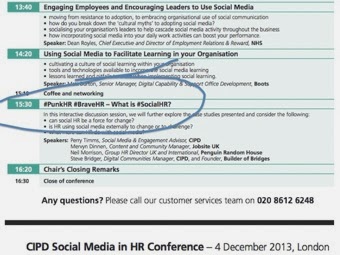
And I worry about the session later on today - #PunkHR #BraveHR - What is #SocialHR?

Forget about the #overkill of #hashtags for a moment (and yes, yes, I know I do it myself) - the combination of terms is just plain wrong.

I’ve got nothing against Punk HR.  It’s not a term or phrase that I’d want to use myself, but I do believe that 1. there is room for a variety of approaches in HR, 2. that we need to move away from best practices towards these varied approaches and 3. that rather than best practices what matters is having an agenda, a bit of ambition, and wrapping HR processes and practices around this.

So although I don’t warm to Punk HR, I’d rather an organisation try to do this, than just copy the same old same old #BoringHR.  However Social HR doesn’t have to be anything punk!  Most organisations won’t want to do punk type strategies and most employees won’t want to work in punk organisations.  Linking them together like this does nothing to attract more businesses of HR people to social media.

And let’s remember the need is for social media in HR to go mainstream - associating it with punk just isn’t going to be helpful.  I know this came up during last year’s conference too and I disagreed with that as well.  The right metaphor isn’t punk rock but perhaps pop (something that appeals to everyone), classical (something that can be part of a traditional organisation) or maybe jazz (everyone doing their own thing but within a co-ordinated frame).

I love Brave HR and have blogged about this here.  The concept was almost first suggested in the #ConnectingHR community and then taken forward by this year’s unconference planning group after receiving my support (though it had been tweeted about earlier and I know lots, though not enough, HR practitioners have been doing it for years.)  But Social HR doesn’t have to be exceptionally brave either (other than being brave will generally help any other HR strategy.)

The use of social media within HR is separate to these two things and to anything else.  Let’s keep it separate and discuss it for its own merits.


But of course, this still isn’t Social HR / Social Business anyway!- which is why I liked @GrumpyLecturer’s challenge: 'Why introduce so me into workplaces where to critique managerial strategies is actions of a non team player?’.

Absolutely.  Social media is an organisation development tool, and like any OD tool, can’t be introduced by itself.  We need much broader, deeper, social change in HR and the rest of the organisation before any business can be anything like truly social.


  • Consulting - Research - Speaking - Training - Writing
  • Strategy - Talent - Engagement - Change and OD
  • Contact me to create more value for your business
  • jon [dot] ingham [at] strategic [dash] hcm [dot] com


Technorati Tags: , , , , , ,


Wednesday, 27 November 2013

CIPD / IASB - HR and Financial Reporting: Why the Value of Talent CAN'T appear on the Balance Sheet!

peg.png
One of the things the CIPD Valuing Your Talent report suggests is that the onus is now on the IASB to explain why the value of human resources cannot appear on the balance sheet as an asset in its right, rather than just as a cost on the P&L.
I’m not sure why they think this is the case, but anyway, in case the IASB is struggling, here are some inputs from my 2006 book which describe why putting people on the balance sheet isn’t just difficult but actually quite impossible.
This doesn’t mean that we shouldn’t support the concept of people as providers of human capital:
'HCM recognizes that people are investors of their personal human capital and that this provides the main source of value for an organization. Of course, financial reporting standards will not allow us to account for human capital in the same way as financial capital, but with a nominal shift from the right-hand to the left-hand side of the balance sheet, the term ‘human capital’ at least implies the right level of importance. It describes an investment, not a cost. It indicates something that can appre- ciate if it is managed appropriately over time, rather than being utilized for short-term gain. It also recognizes that organizations do not have to own the capital to utilize it, but that it will only be made available for as long as investors (the people working for the organization) gain value in return for making their investment.'

And if we could somehow put people on the balance sheet that would be great:
'Organizations may recognize their employees as their most important asset but our reporting requirements do not allow them to be considered like this. Spending a million pounds on training employees is treated as an expense and would have an immediate impact on earnings. If expenditure on training was treated as an investment, these costs would be treated as assets and capitalized on the balance sheet. So the same spending would be depreciated over the useful life of the training and earnings would be reduced gradually over this period. Treating this spending as an investment would also mean that it would be much more likely to be monitored over the period it is amortized for.'

Unfortunately, we can’t.  To be able to do so, we would need to be able to to a direct valuation of our stocks of human capital:
‘The assumption in direct valuation is that intangibles have an absolute, fixed value. This can lead to some further questionable conclusions. For example, it can be taken to mean that intangibles account for an absolute part of market value and potentially the difference between book and market value. In this situation, it makes sense to quantify each type of intangible capability in order to justify market value and keep share prices high.
I believe the search for an approach to direct valuation will also prove futile. It has already become less popular since the downturn in the stock market in March 2000 when it became clear that intangibles could not be measured as a simple differ- ence between market and book values but involve a more complicated relationship than this. A powerful criticism is that direct valuation tries to cope with complexity by pretending it does not exist and this can be dangerous if it leads to managing in an inappropriate way.'

(Multiply my comment about the downturn in 2000 by 100 for the recession in 2008!)

The only way we can value human capital appropriately is indirectly:
'In this perspective, which takes more account of complexity, intangibles are just the cause, not the substance of the difference between market value and financial value. Intangibles have no self-standing value in themselves; their value is created through their potential impact on future earnings. Investors’ expectations about these future earnings are what results in a company’s market value. These expectations are influenced more by intangibles than tangible assets because the market believes that intangibles will have a much bigger impact on future earnings than tangible assets. So investors pay for the expected impact of intangibles, not the intangibles themselves.
But the expectations of investors are subjective. Market value is only indirectly affected by intangibles and is also subject to a number of external factors including the political and economic climate, actions of competitors, changes of technology and general rumour. Some models introduce an additional element, ‘market premium’, into company valuation. This market premium is based solely on investors’ subjective perceptions about the future and means that it is now the adding together of financial capital, intangible capability and market premium that results in market value. However, it seems much more likely that the whole entirety of market value, not just a smaller market premium, is the result of investors’ subjective expectations. Intangible capabilities are the main driver for these expectations, but they cannot be the basis of an absolute calculation of intangible value.
An indirect approach to measuring intangibles recognizes that intangibles and the processes that are used to develop them only result in increased financial value through their contribution to business activities. For example, Kaplan and Norton explain that:
"The value of an intangible asset such as a customer database cannot be considered separately from the organizational processes that will transform it and other assets – both tangible and intangible – into customer and financial outcomes. The value does not reside in any individual intangible asset. It arises from the entire set of assets and the strategy that links them together."

Kaplan and Norton note that creating value from intangibles differs from managing physical and financial assets in four important ways:
1. Value creation is indirect ... Improvements in intangible assets affect financial outcomes through chains of cause-and-effect relationships.
2 Value is contextual ... The value of an intangible asset depends on its alignment with the strategy.
3. Value is potential. The cost of investing in an intangible asset represents a poor estimate of its value to the organization. Intangible assets ... have potential value but not market value ... if the internal processes are not directed at the customer value proposition or financial improvements, then the potential value of employee capabilities, and intangible assets in general, will not be realized.
4. Assets are bundled ... Maximum value is created when all the organization’s intangible assets are aligned with each other, with the organization’s tangible assets, and with the strategy.” '

It was interesting to hear someone at the CIPD conference challenge Peter Cheese and Anthony Hesketh about they work using this point that human capital is potential.  It’s absolutely the central point here.  Human capital does not have financial value until it’s put to use.  It therefore can’t be put on the balance sheet.  Simple.
However, in case you want it, my more comprehensive argument continues:
'Rather than trying to ‘fix’ accounting, this perspective realizes that financial accounting does not attempt to convey the market value of a company on its balance sheet. All it does is to value a company’s assets in accordance with financial reporting standards. International Accounting Standards (IAS 38) specify that a company can only recognize an asset if it is identifiable and controlled.
Control means that an organization has the ability to gain future economic benefits from an asset and to restrict the access of others to these benefits. If an asset meets these requirements then it should normally be amortized over the best estimate of useful life up to a maximum of 20 years. However, companies do not own an individual’s human capital so it cannot be controlled. It therefore lacks the essential characteristics of an asset. In fact, the standards specifically prohibit capitalizing internally generated goodwill, brands, publishing titles, customer lists and similar items including staff training costs. Outlays on intangibles therefore need to be recognized as expenses when they are incurred.
The important pointis that the accounting standards do not exclude intangibles from a balance sheet because they are too difficult to include. The real reason is that they do not really belong there. As Boston Consulting Group explain:
"The fact that companies don’t own their employees, as they do their capital assets, is why methods for valuing ‘human capital’ on balance sheets are so tortuous."

Keeping intangibles off the balance sheet means that the information on it is still relatively comparable. But it also needs to be recognized that the total value of the balance sheet will not reflect the market value of the company and that some of the things that are not on the balance sheet will be more important than what is included.
In this perspective, financial reporting still needs to be improved to meet the new, broader information needs of its users, but by developing and improving non-financial forms of reporting. Rather than changing the information that is included in the financial accounts, the need is to share more knowledge, to describe qualitatively what an organization is doing, and the sorts of intangibles it is creating, in order to provide earnings in the future. This is what Becker et al. are referring to when they encourage HR to take a different approach to measurement:
"The bottom line is this: If current accounting methods can’t give HR professionals the measurement tools they need, then they will have to develop their own ways of demonstrating their contribution to firm performance ... Investors have made it clear that they value intangible assets. It’s up to HR to develop a new measurement system that creates real value for the firm and secures human resources’ legitimate place as a strategic partner."

The rest of the book goes on to provide the required new measurement system that demonstrates HR contribution to firm performance that creates real value and secures HR”s legitimate place as a strategic partner.
You can buy my book here (and on Kindle).

But going back to the CIPD report, this is where they have messed up.  We can’t put people on the balance sheet.  We can’t accept accounting’s current paradigms about reporting and try to squeeze HR into them somehow.  We have to educate other business communities that this is the only way to effectively report on HR.
What gets me slightly irritated about this is that both Peter and Anthony should know better.  Anthony in particular endorsed my book but seems now to have forgotten about the content and the complexity involved in reporting on people management:
"That people’s capacity to unlock the performance of organizations is far from a simplistic and causal model is hardly new. A book offering a new way of explaining how such complexity can be managed and harnessed for the good of organizations certainly is. This is a book to address HR’s continuing inability to think outside the box of how people influence performance. Read, reflect and act."

Dr. Anthony HeskethDirectorCentre for Performance-Led HRLancaster University Management School

I did however appreciate Anthony's comments during the CIPD conference presentation about my great website.  You’re reading it now by the way! - do come back again…

And also see:

Or contact me at:
  • Consulting - Research - Speaking - Training - Writing
  • Strategy - Talent - Engagement - Change and OD
  • Contact me to create more value for your business
  • jon [dot] ingham [at] strategic [dash] hcm [dot] com

Technorati Tags: , , , , , , , ,

Tuesday, 26 November 2013

CIPD - Valuing Your Talent

Screen Shot 2013-11-24 at 16.45.15.png
There’s also more I disagree with in the CIPD’s attempt to re-establish Accounting for People through a project called Valuing Your Talent and which was launched with another research report at the CIPD conference.
Despite the change in name, this project is basically recycling Accounting for People, and adding an additional, dangerous twist.
It’s the same because it’s trying to do the same two things:
Firstly, it’s attempting to define externally reportable metrics for things which are standard across all businesses.  These may not be that important, but if they can be defined and standardised, why not?
Well the two main issues with this are that A4P failed to reach any agreement on what these standards should be, and I’m not convinced that VyT will do any better.  And also that SHRM have recently defined some standards anyway, but failed to get anyone to want to use them.  Eg at the conference, Peter Cheese suggested there is no standard definition of headcount, but there is - see p8 in this SHRM document, it’s just that this wasn’t adopted by the American National Standards Institute.  And once again, I’m not convinced that the CIPD will manage to do any better.
The only good argument I’ve heard for us being able to do this when the Americans failed was a point provided by Ann Francke CEO at the CMI (one of the CIPD’s partners in VyT) who I met whilst putting together a research report for the EIU (which was unfortunately never published) earlier this year.  Ann suggested that 8 out of 10 of ISO’s standards including the big four: 9000 for quality, 14000 for the environment, 18000 for health & safety and 27000 for information security were developed first for BSI in the UK, as we have a better understanding of the value of standards.  So maybe this will help move things forward here?  But I’m not convinced.
The CIPD have grouped these metrics into two: Regulatory metrics, required for legal and similar reporting, and Transactional elements which some investors and others say they want, though that’s different to having a definite need to use them.  They probably are amenable to standardisation, with enough time and effort, but the key question remains - will anyone care?
BYecNIGIEAAD9Z0.jpg_large.jpg

Secondly, VyT is trying to come up with standards for more strategic measures which are much harder to measure.  These include analytical metrics such as engagement levels, and transformative metrics such as human capital enablement, utilisation and traction.
A4P suggested measures like these would need to be left to narrative reporting and SHRM also left them to a more qualitative 'Human Capital Discusion & Analysis’.  Good luck to the CIPD in findings some quantitive standards for these.  In fact during the conference presentation, Anthony Hesketh suggested the CIPD’s accountancy partners were only just about on board with engagement survey results and certainly weren’t going to go along with something like a social network analysis - a tool which is potentially more important but less easy to measure.
That’s the problem A4P found too - the more important the measure it, the less possible it is to make it into a metric!

Then there’s the dangerous twist - the top line in the slide diagram: putting human capital on the balance sheet.  No, no, no!!!  Now we’re into really troubling territory.  It’s no longer just that metrics are difficult at this point, it’s that they’re completely impossible.  And if we try, we’re bound to get dysfunctional results.  I’ll come back on this again soon...

Actually, before I finish, I should note that there are aspects of the research report I agree with - and this seems much more balanced than Peter Cheese and Anthony Hesketh’s conference presentation.   I do agree for example that where it is possible to do so, we should try to make the intangible more tangible.
And I love some of the comments in the report about HR as an art, or craft:
'Where the numbers finish, the executive craft begins
Of course, it is not all about numbers. Many grate at the description of human resources as an asset ripe for greater exploitation. While the accounting profession is for the first time getting to grips with the notionof an asset as aresource, the HR profession has steadfastly defended the human element in HRM.
There is a large element of executives who do not require the accounting, academic or consulting industries to prove something thatthey already know to be true: good management makes a difference tohow people perform.
It is for this reason that VyT is looking beyond the capitalisation of human resources to how we value our talent and our management practices as more art than science. Alongside the development of a raft of metrics we are investigating the craft of thehuman resource executive’s art. This in turn requires methodologies that utilise the narrative form to capture a company’s competitive intangibles.

This is much more like it. Though my preference at least isn’t due to any ‘grating at the description of human resources as an asset ripe for greater exploitation’ (or the fear the CIPD believes exists that it described in its analytics and big data report), it’s just  a different, and I believe perfectly valid (and correct!) perspective on the role of measurement.
Oh, and I’ve no idea what this is about at all! (whatever it is, it isn’t art!)
Screen Shot 2013-11-24 at 14.50.35.png

It’ll certainly be interesting to see where this goes, though I don’t hold up much hope for it.  Sure things have changed since 2004.  The CIPD are right to signal the opportunities provided by changes in international financial reporting standards (IFRS) and integrated reporting (IR). But these are peripheral issues.  Nothing fundamental has changed in the fundamental difficulty of capturing the most important aspects of people management in standardised form.
Anyway, I think this difficulty is probably a good thing as there’s probably as much chance of the project doing damage as it doing good should it succeed.
I certainly can’t see the project ‘creating a movement’ in the way it suggests.  Firstly because movements come from crowds not managers and secondly because it’s too late to do so - engagement comes from participation, not from being sold things that have already been decided.
So it’s great that the CIPD, through the RSA, intends to use innovative social media to gain input from a breadth of stakeholder groups, but actually it’d be even better to have used the social media that already exists (eg by involving bloggers before this thing was launched.)
But as the project has already decided that “in the present context of concern and expectations about corporate cultures, we have to finally agree more consistent measures and frameworks that provide the visibility all stakeholders need” (do we?, is that the right choice? will this solve the real rather than the superficial problem?) it’s too late for me at least to get on board.

Also see:

More on this again tomorrow...

  • Consulting - Research - Speaking - Training - Writing
  • Strategy - Talent - Engagement - Change and OD
  • Contact me to create more value for your business
  • jon [dot] ingham [at] strategic [dash] hcm [dot] com

Technorati Tags: , , , , , , , ,

Monday, 25 November 2013

CIPD - Talent analytics and big data

Screen Shot 2013-11-22 at 20.25.28.png

In my last post I argued that the CIPD has got things wrong in arguing for the focus on analytics in their new framework.  Well I disagreed with this top-level focus, and I disagree with the detail in their new research report, ‘Talent analytics and big data - the challenge for HR’ as well.

But I first need to note that I’m not against analytics or big data - I’m strongly in support of using both things.  I also do like a lot of the report.  Silos are a problem for HR teams, and the siloisation of data and systems compounds the problems that these should help solve.  And HR’s skills in the measurement and analytics space do need to be enhanced.  (I also like the suggestion that HR professionals should focus on telling stories from the stats [‘nobody likes dry statistics’].  I agree with the suggestion on stories - I just don’t believe you always need statistics in order to tell them!)

But just because big data is important, and we need to improve what we do in the area, doesn’t mean that we should let analytics take over from our focus what’s even more important, and that we already do reasonably well!

And I simply don’t believe that analytics are going to provide the basis for the leap forward we need to make in the profession.  I like one of the interviewee’s comments in the report that ‘the fact that HR wants to move into the place is good as it complements and balances the gut-feel approach.’  I agree, but I think the rest of the report forgets about the importance of this duality.

I also strongly object to those of us who have a more nuanced view about the utility of big data to be discounted as suspicious and afraid!  We have a reasonable (and I believe accurate) point of view, and it demands to be taken more seriously!


Let me explain -

The report makes a big thing of the problem in the take-up of analytics being what is called suspicion, as well as silos and skills.  This is about the cultural barriers which can ‘subtly undermine the people analytics effort.’  These cultural barriers include ‘biases and beliefs about where HR’s expertise lies’ and even ‘fear that data might reduce human beings to units of measurement!’.

This is just one example of the report distorting rational, critical arguments into emotional ones which most people will disagree with.  We, or at least I, don’t think data will reduce human beings to units of measurement, we just don’t believe measurement can ever fully describe the full qualities of these people.  That means that whilst measurement is important, it can’t be the big solution to our current needs.

The report goes on...

'Fear

While it’s clear that HR is engaging with the challenge of big data,it’s also clear that this is not inthe comfort zone of many. Some feel that the advent of analytics compromises a more thoughtful and grounded HR practice. Few articulate this openly, but there is unease. The term ‘big data’ is sometimes associated with ‘bigbrother’ surveillance, control and an ICT and technology focus. The idea that this approach dehumanises and disempowers people is one strand of thinking commonly encountered in the learning and coaching space.'


Well, those who are concerned about a more thoughtful and grounded HR practice are correct in my view!  An excessive focus on metrics and analytics can compromise our effectiveness.  The more we focus on data, the greater the risk of losing sight of the forest for the trees, and reducing not increasing our insight about our people, and the effectiveness of our approaches.  And the approach also leads to absolute and dangerous nonsense like the belief that “If HR can’t measure what it does and prove the value of what it does then it shouldn’t be doing it” (Accenture again).

The report also notes that 'analytical people don’t live in HR - HR people are better at managing ambiguity than analysis' - well, perhaps there’s a reason for this (that this is the skill which is really most important and that we need to develop even further)!

There’s more too...

'There is also a fear outlined in our skills and smarts section that,since the capability to do this is not within HR, external specialists without the insight and nuance of HR will drive the approach. HR might be sidelined and kept out ofthe loop. There is also a perception that the insight generated might be less nuanced and more focused upon performance and productivity, with questions about the sustainability of such an approach.These concerns will need to be addressed along with the other issues of silos and skills if HR is to engage fully with this compelling opportunity.'


This repeated use of the word fear strikes me as deliberately emotive and pejorative language designed to discount views which oppose those in the research.  We’re not afraid, we just don’t agree!  This is what gives us a ‘certain comfort in sticking to our strengths’ - not some sort of stuckness based on fear.  I thought one of the interviewees in the research summer it up well:

“For me it’s just a buzzword that people are using to make themselves feel clever. Everyone else is just wanting to get on the bandwagon. The issue is what kind of stuff? You don’t always need to push the envelope and be ahead of the curve. People misunderstand the challenge: what’s the operational talent data? For a start you need a clean definition of talent which is clear. The unstructured [data] issue is promising, but what’s theincremental value? How is it going to drive my business in a leading-edge way? Not sure it (big data) can add real value…"


There are no quotes in the report of anyone saying anything like ‘I’m really afraid of big data!’ so I presume this thing about fear is the report writer’s interpretation of why people are ‘resisting’.  The following comment seems to confirm that this is an interpretative overlay over the research findings too:

'Suspicion and scepticism

Suspicion and scepticism is hard to identify, but behaviour and priorities can sometimes give us more insight than what people tell us in surveys or interviews. This is because there is anxiety and concern that HR is being asked effectively to jump the talent analytics and big data hoop when the issues of silos and skills are working against the ability to do that. Scepticism about whether a data-driven world would be better than the one we are in also abounds. The fact that a number of organisations we talked to for this project refused to be quoted is instructive.'


I’m happier about the use of the word scepticism than I am about the accusation of suspicion (defined above to relate to peoples' biases and fears).  However once again any rational, critical scepticism about the over-exaggerated potential of analytics and big data is distorted into a more general, quasi-flat-earther perspective (fear of the new data driven world).


So what I find really interesting is that the report itself demonstrates just how limiting a focus on data and analytics can be.  That is, that even after what seems to be a sound research approach (interviews with individuals from ten different organisations, survey data over two time periods and what is described as an extensive review of literature on the topic), presumably leading to a set of sound findings, the conclusions can still be so completely off the mark.

To me, this reinforces the central fact that it’s not the data but the insight this provides that is important - and this is where we need to focus our effort.  And insight is still as much about gut-feel as it about all this other malarkey.


BTW, whilst I’m on the subject of the research process and the literature review, I would just point out that the report mentions just 21 references within its extensive literature review and that this included no blogs - which is increasingly the place where new ideas are brought forward.

I think the CIPD is still a little suspicious (hah!) when it comes to social media.  And OK, citizen journalists do more obviously have our own axes to grind.  But at least I admit to my own biases as a blogger, and my blog is still a paragon of neutrality compared to this report!

Anyway, perhaps if the database had been widened out a bit and made more topical, it would have led to sounder conclusions too.


For example, what about the main problem in analytics - strategy!?

The report notes that analysts may be operating without a full understanding of the purpose of analysing people data, leading to a ‘bean counting’ approach to the measurement of people, but it doesn’t probe any further.  But in my view, poor, or lack of, strategy is a much more important and valid problem than the other three s’s that provide the focus of the report.


There are some important issues in all of this.

For one thing, I worry that the report is likely to mean that even more excessive focus gets put into measurement and analytics, rather than where the strategic need really lies.

It may also be one the main factors that have led to the CIPD putting so much focus on science and analytics in their new framework (see my previous post.)  Despite Andrew Marritt’s well through through response, I still think that’s a mistake as well.

Thoughts? 


By the way, and to save you from having to comment on this point at least, I am aware that rather than just carping at other peoples’ work, I should probably outline my own beliefs about analytics here.  And I just may do that later in the week.  In the meanwhile, you can take a look at these posts I wrote earlier (and if you’ve enjoyed this rant, you’ll probably like the way I lose my rag in the top two of these as well):


And I am going to continue my post-CIPD rantorama on a related field - external reporting - tomorrow (that’s if I dare!)


  • Consulting - Research - Speaking - Training - Writing
  • Strategy - Talent - Engagement - Change and OD
  • Contact me to create more value for your business
  • jon [dot] ingham [at] strategic [dash] hcm [dot] com


Technorati Tags: , , , ,