Showing posts with label InfoHRM. Show all posts

Monday, 30 November 2009

Developing your 2010 Human Capital / Talent / Workforce / HR Strategy & Plan


I’ve previously posted on my Human Capital Management Strategy, Talent Management Strategy and Workforce Planning processes, but I haven’t written about how these processes can be combined.  This is partly because doing so may seem a little nit picking (these terms are generally used indistinguishibly).  But I believe the differences are important (according to Peter Cheese’ data, organisations that score in the top quartile of business results score an average of 3.4 for maturity of Human Capital Strategy, compared to just 1.8 for those organisations in the bottom quartile).

And although I have a lot of time for InfoHRM and their Workforce Planning process that I described in my last but one post (remember that I tend to be most critical over areas that I largely agree with), I think HCM Strategy involves more – and provides more benefit.

For InfoHRM, WFP is the maths behind Demand –Supply = Gap.   And HCM Strategy is about the actions taken to deal with the gap:


It’s all very well thought through.  But for me,  HCM Strategy is about the type of place an organisation wants to become.  It’s a higher level of strategy / planning than WFP and needs to come first if an organisation is going to maximise the value it gains from its people:


Human Capital Planning

This is about choosing the sort of human capital or organisational capability that’s going to make a difference to a particular organisation; doing a diagnosis of the current level of capital; working out how it can be best created and setting objectives for this (in the top row in the HCM Value Matrix).

It’s about deciding on the type of place an organisation wants to become; what it wants to provide to its people; what sort of people it needs and what it needs its people to deliver etc.  And it’s a vital step in meeting Richard Boyatzis’ challenge about accumulating rather than liquidating human capital which I think is essential is an organisation is going to create value and provide competitive advantage through their people.

It doesn’t need to be performed every year necessarily but I’d suggest it should when facing major changes in the environment such as the one we seem to be entering at the moment ie recession to jobless growth.

Note that I’ve put Human Capital Planning at the same level of business planning in my slide, above to emphasise that the business plan should be informed by the Human Capital Plan as well as the other way around.

Another important aspect of my approach is that the focus of energy is inside the organisation – on the things the organisation can already do well and can be developed into differentiators (ie its mojo / organisational capability)

See:


Talent Planning

This process is about identifying the talent groups that require particular attention within the strategy.   These people may be high performers (‘A’ players), but they may be other people / groups too (see my last post on differentiation).

One important part of this process is the identification of Employee Value Propositions (EVPs) for each of these groups.

This is a really vital step in HCM strategy development, and lies at the heart of the Human Capital Strategist programme that I deliver for the Human Capital Institute (in UK and Europe).  I also think Dick Beatty describes its value well.  But I believe it needs to come after Human Capital Planning as the identification of talent groups needs to be informed by organisational capability, not just critical business processes.  But it needs to come before Workforce Planning because the identification of talent is an input, allowing WFP to focus on what’s really important, rather than an output of this process.  (There may however need to be some iteration of this, for example if WFP throws up critical constraints in the supply of various groups which then may also need to be considered to be talent).


Workforce Planning

This process is about a more granular level of planning, diagnosis and strategy development, and as much as possible should be data based.  (I don’t believe you need to get into numbers earlier on in the human capital strategy development process, and I’ve been involved in several cases where doing so has obscured rather than clarified strategy making.)

See:


HR Planning 

Another input into Workforce Planning is more traditional HR Planning.  This looks at how people can be used as Human Resources to help meet an organisation’s mission, BHAGs, business plans and objectives.  It leads to the setting of objectives in the middle row (adding value) in the HCM Value Matrix.

It’s it at this level that HR needs to be business first, HR second (at the left-hand side of the slide, I think we need to be HCM professionals first).

See:


HR Process Planning

The third level of planning looks at HR processes and how these can be improved, based on best practice, benchmarking etc (rather than how these fit the particular needs of the organisation).  These requirements become objectives in the bottom row (value for money) in the HCM Value Matrix.

See:


Scorecard Development

At each level of Human Capital Planning, Talent Planning and Workforce Planning, an organisation should develop then iterate objectives for their HCM Strategy.  Once they’ve completed this analysis it makes sense to develop measures to support these objectives.  This process provides an HCM Scorecard based upon the HCM Value Matrix.

See:


Scenarios

InfoHRM note that scenarios help manage change and risk by developing alternative views of the future based on events outside the organisation’s control.   This helps the organisation rehearse how it might adapt to future events today (what if?).

I agree with the importance of scenario planning but believe it needs to start at the beginning of the strategy development process (ie in Human Capital Planning) and be iterated at all three levels

See:


Note, whenever I work with organisations this process ends up looking very different from the one I’ve described here.  I’m not actually a big supporter of methodologies, at least in this sort of area.

But the process I’ve described is the ideal one I’ll have at the back of my mind when I’m talking to a potential or new client.  And we’ll then develop something that will work best for the particular client based upon this insight, but also the client’s particular strategies, external environment, internal context etc.

See:


  • Consulting - Research - Speaking  - Training -  Writing
  • Strategy  -  Talent  -  Engagement  -  Change and OD
  • Contact  me to  create more  value for  your business
  • jon  [dot] ingham [at] strategic [dash] hcm [dot] com

.

Sunday, 29 November 2009

Differentiation for Workforce Planning


   In her session on workforce planning at Starbucks, Lacey All talked about the need to ensure resources are deployed against pivotal roles and key talent segments in order to remain flexible in responding to current and future business innovation demands,

Well, I’d understand it if you feel I’ve done the these of workforce differentiation to death, but I think it’s one of the most important issues in strategic people management today.  As Row Henson from Oracle mentioned in her session on Measuring Performance (quoting Dave Ulrich) the value of top performers can be 12 times the performance of average employees.  So I hope you’ll let me dwell on it a bit longer.


I recently wrote my 5th post on Dick Beatty’s Differentiated Workforce (this is my 6th).

In general, Dick’s presentation made me feel a lot more positive about his approach.

  • Rather than linking strategic / A roles to critical business processes, he focused much more on ‘capabilities’ as the basis for identifying talent groups.  I thought this was much more positive because it means he is putting the overall shape of the organisation ahead of talent by itself.  This is my approach as well – identifying and investing disproportionally in talent is often going to be an important aspect of HCM strategy, but not, in my view, as important as differentiating the organisation as a whole.  [Note however, that although Dick uses the word ‘capabilities’ he says himself that he really means ‘core competencies’.  I believe that 'true ‘organisational capabilities’ provide a much sounder base for HCM strategy so I tend to start with these.]
  • Dick also showed how capabilities and therefore strategic roles differ across organisations within a sector (Nordstrom and CostCo).  This was an omission in Beatty’s book (at least I couldn’t see it) and one of my major concerns, as I couldn’t see how the approach was differentiating if all organisations within a sector had the same strategic roles!


However, I still have concerns, including:

  • I don’t believe differentiation is necessarily the right approach all of the time (eg organisations with a capability of inclusivity).
  • I don’t believe that differentiation always needs to focus on A roles and A people.  Pivotal talent are another quite possible option for example.  [Row Henson again (lifting from John Boudreau this time): "Who's the most pivotal person at a Walt Disney resort?" she asked. "I'd argue it's the man or woman who sweeps the streets at the end of the day. These won't be top performers in the classical sense of the word, but they are pivotal because, if the resort is dirty, customers won't want to return."]
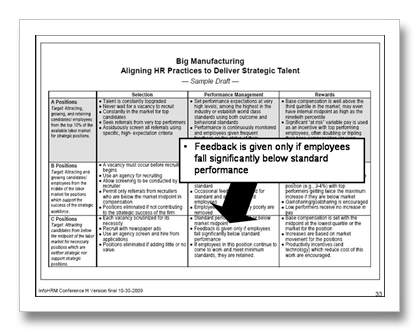
  • I don’t agree that organisations which do differentiate as Dick Beatty suggests should deliberately search out C candidates for C roles.  I’m with Jack Welch – you want to raise the calibre of the whole organisation – including A, B and C roles / people.
  • When you do have people working in C roles (that you’ve not yet made leave the organisation), I’d suggest you still need to focus on raising their capabilities and performance.  I don’t agree that you should deny them feedback or as Row Henson suggested, have ‘a list of people not to develop’.  I don’t believe that doing this would allow you to invest any more time or resources in supporting people in A roles / A people.  It’s just going to mean putting even more time into looking after, correcting the mistakes etc of the C players who don’t know how they can improve.


So, organisations that want to differentiate themselves (and doing so is pretty fundamental to gaining competitive advantage through human capital), have to ask themselves a number of questions (* although of course they can also ask for my help! *), including:

  • How are they going to differentiate themselves, ie what organisational capabilities are they going to develop?
  • Which talent groups support this differentiation, and how can they best define these?
  • How can they best support each of of these groups differently?
    • See the following slide from Peter Cheese, ex-Accenture, from his presentation on talent management at the CIPD conference:


In dealing with the second bullet point above, it’s useful to know that talent can be defined in a number of different ways:

  • Key people
  • Key roles
  • Key people in key roles (Beatty)
  • Pivotal talent (Boudreau)
  • Scarce talent (from workforce planning)


  • And based upon a range of other factors, including individual talents’ demographics and perspectives (a true HCM strategy will differentiate according to their talents’ needs, rather than their own) – see another of Peter Cheese’s slides:


(Note that for Cheese, using Beatty’s approach isn’t pushing the envelope or leading edge, but is merely typical of what happens today (if done in a rather more sophisticated way).


What do you make of all that?

            Are you differentiating your organisation through your workforce?

                        And are you differentiating it in the most optimal way?


  • Consulting - Research - Speaking  - Training -  Writing
  • Strategy  -  Talent  -  Engagement  -  Change and OD
  • Contact  me to  create more  value for  your business
  • jon  [dot] ingham [at] strategic [dash] hcm [dot] com

.

Saturday, 28 November 2009

Lacey All, Starbucks on Workforce Planning

   I’m finishing off posting on the CIPD conference with some notes on future human capital / talent / workforce planning.  But before I bring this all together, I want to do a short review of the session on workforce planning from Starbucks’ Lacey All.  Partly because I thought it was an excellent presentation of a great case study (and Lacey hadn’t even had any coffee!), but mainly because workforce planning does fill a central role within human capital planning.

I think I4CP explained this role quite well in their recent post claiming that workforce planning Is the ‘missing link’ for HR – helping to combine the business strategy and HR strategy:

“If your bead on the future is looking blurry these days, you're not alone. The global recession has thrown off a lot of organizations' expectations and predictions. So, it's little wonder that many are now striving to do a much better job of strategic planning for the future, especially in the area of talent.”


And at the conference, Peter Howes from InfoHRM explained how workforce planning can assist organisations to better manage within this new economy:

  • Replaces a reactive approach (reduce headcount across the board, cut labour costs by x%) with more precise interventions
  • Decisions are based on clearer understanding of critical factors and relationships –in effect, a ‘risk audit’
  • Which roles or jobs have biggest business impact?
  • Which will be hardest to fill internally and externally in the future? Which have the steepest or longest learning curve?
  • Which skills and competencies will become increasingly or decreasingly valuable to future performance?
  • Which talent segments need to be protected as feeder pools?
  • Organisations can model alternative scenarios to compare long-term consequences for talent supply.


In her presentation, All explained that their approach to workforce planning doesn’t attempt to be the same thing for everyone, but consists of a number of activities ranging from operational to more strategic:

  • Retail forecast tools
  • Dashboard analytics
  • Ad-hoc analysis
  • Environmental scanning


  • Talent segments
  • Pivotal roles
  • Planning workshops
  • Action planning and progress monitoring.


The focus on retail here is about this being the area which will differentiate Starbucks’ brand and create a competitive advantage.


I thought the most interesting part of the session was the outline of Starbuck’s planning workshops.

In these sessions, leadership teams consider:

  • The environmental scanning reports shown above (what affects my workforce?)
  • The current state (where am I now?)
  • No change future state (where am I heading if everything remains the same?)
  • Scenario planning (what’s my ideas vision given different operating climates?)
  • Targeted future (what is my targeted or likely future?)
  • Action planning (how do I get there?)
  • Setting up progress monitoring (is my plan right?, am I on track?).


A key issue at the moment is understanding ghost turnover – and predicting how many people will leave post the recession.

Some of the external factors the teams look at include:

  • Demise of a Competitor
  • Unionization of Workforce
  • Distribution Optimization
  • Process Teams don’t have the right capabilities
  • Full Automation of Production Lines
  • Failure to open 5th Roasting Plant at 75 mm pounds
  • Store of the future.


Although workforce planning is often closely linked to workforce analytics (particularly when considering the current state / supply of the workforce), All stressed that lack of data (outside the US) doesn’t stop them doing workforce planning, and that the process is as much art as it is science.

The outputs of the planning workshops are solutions to close critical gaps in the future workforce.


All useful stuff – so why aren’t many organisations doing this (and why were so many people walking out during such an excellent presentation?).

Actually, the situation may not be that bad – I4CP notes that the use of workforce planning is trending upward. About 70% of the respondents to their survey said that they are doing some form of workforce planning in their organisations today, and 43% of those who are not doing it now plan on implementing this process in the future.  But that doesn't mean that most companies are doing it well:

“There are three types of workforce planning: operational, tactical and strategic. While most organizations with WFP are highly engaged in short-term operational workforce planning - which includes actions such as headcount forecasting and staffing requisitions - relatively few are highly engaged in long-term strategic workforce planning, which includes actions such as business planning, needs assessments and scenario creation.”

If you want to gain more of the benefits that Starbucks are clearly getting, you may want to review:


  • Consulting - Research - Speaking  - Training -  Writing
  • Strategy  -  Talent  -  Engagement  -  Change and OD
  • Contact  me to  create more  value for  your business
  • jon  [dot] ingham [at] strategic [dash] hcm [dot] com

.

Saturday, 14 November 2009

InfoHRM conference – Europe 2009


A quick summary of my two days at InfoHRM’s European conference on workforce measurement, workforce analytics and workforce planning.

Peter Howes and his team believe more strongly in the power of metrics than me, but in general, I support their approach, eg the need to gain a “multi-dimensional view of data to get true insights”, and for “hypothesis setting as well as measurement”.

I also agree that workforce planning needs to inform, as well as result from, the human capital strategy.  I just (still) think that in general, the issues tend to be so significant, and the opportunities so vast, that value creating strategy development depends on ambition, courage, creativity and the understanding of human and social behaviours, more than it does on measurement.  It’s why in my model, measurement follows on from strategy.


Communicating workforce analytics


I also agree that what organisations do with the data and analysis they produce is as or more important than generating the data and undertaking the analytics.  Deciding how best to communicate the findings of analytics is as important as increasing understanding of what the data means.

One way of doing this is through visualisation and Stephen Few, Perceptual Edge provided a great explanation of how to tell stories using data.


Workforce Analytics capability


And I also agree that whatever the approach, HR’s capability in understanding and using data needs to increase.  This is something we spent quite a bit of time on today.

Thomas Otter from Gardner suggested that the skills gap within workforce analytics is a big issue – there’s a lack of people interested in both HR and in analytics – the function needs to learn to love numbers.

David Guest from King’s College asked why more organisations are not using the data that exists on the value of good HR practices.

“Organisations, particularly Finance departments, look at people as one of the easiest variable costs to cut.  When the Finance Director comes in to say you need to cut 9%, how many HR departments have guts to question this?  HR is often an executioner of policy driven by Finance without a lot of thought.”


According to Peter Howes, it’s unlikely that all these capabilities will ever exist in the same person, so he identifies three roles: HRIS analyst, business analyst and business partner.  And it’s worth bringing these together into a centre of excellence focussing on workforce analytics.

And later on, Jacquie Heany from the Cabinet Office provided an overview of changes in the UK Civil Service HR:

“By developing HR capability [in workforce analytics], it’s moving there [a strategic role] because it can”.


  • Consulting - Research - Speaking  - Training -  Writing
  • Strategy  -  Talent  -  Engagement  -  Change and OD
  • Contact  me to  create more  value for  your business
  • jon  [dot] ingham [at] strategic [dash] hcm [dot] com

.

Dick Beatty on Differentiated metrics for a Differentiated workforce


   I had some quite long conversations with Dick Beatty at the InfoHRM conference.  It’s the first time I’ve really talked to someone who I have posted on quite extensively, and who has also already read my work, which I found quite interesting!

This is my summary of Beatty’s presentation.  I’ll come back to whether I’ve changed my views of his approach at all later on.


How do you build great organisations through metrics?  Beatty often speaks to CFOs. Where, how and who creates wealth for a firm is a major issue.  Understanding how HR can create value for business.  How do we use culture and talent to impact the bottom line?  We need to score on the bottom-line of the business, rather than the HR scorecard.

CEOs care about two things:


1.   Strategy

Every HR person wants to be a strategic partner / player.  But what does strategy mean?  It’s about value creation - customer value and economic value.  Firms provide society with value which society has the option to choose upon.  The better we serve the better our customers like us.  The more we can do this in the way our customers like, the more our shareholders like us.  HR doesn’t think enough like a real strategist.


2.   Data analytics

Numbers are the language of organisations.  You can’t win arguments through moralsuation.  Strategy needs to drive measures.  Measures need to drive decision making.  Think of surveys as communicating to your workforce about what is  important. Don’t ask about things no one cares about.  Needs to be interventionable – able to intervene to do things differently.

We want to get to the table.  What do we have to bring to the table and how do we get invited back?  There are various measurement frameworks: Saratoga, Jack Phillips, John Sullivan etc.  But these focus on getting the answer and then figuring out what we’re asking.

A better approach is to figure out what are the qs that are worth asking?

If you had the right data you could intervene and get the right solution.


Differentiation

Eg Avis ‘we try harder’ – why not try different?  Strategy is about customer value and uniqueness.  So how do we differentiate the workforce?  Where do we make extreme investments in talent?

We’re entering an economic era of great volitility – customer requirements are changing.  It’s causing us real pause in how we build organisations.  A big implication is workforce agility.  Firms need to ask how do we minimise fixed cost?  Well, the biggest cost in most organisations is the workforce.  Financial services: 91%; Oil & Gas: 16%; Average about 70%.  A good example is IBM’s On-demand strategy / on-demand workforce.

How do you build great organisations through great talent systems?

The key questions are:

1 How are we going to grow?  Where do we play?  How will we win?  If you don’t know where you’re going any plan will get you there.

2 How do you use resources to execute strategy?  Need systems to do this.  If you loose inventory no one cares too much.  If you mis-manage the workforce they do.  How do you build a resource management system for the management of the workforce?  There are stars in the workforce but you also need a star system to do this.  Manage your workforce like a portfolio and leverage its return.  Look at talent as a supply chain.  What’s our inventory and what are we going to do about it?


Strategic capabilities

We need to look at the enterprise the way investors look at the enterprise.

What are you going to differently to get different?  Organisations don’t do things differently - people do.  Get people to change or change the people.

We tend to think about culture / talent as lag variables.  (We’ll do it once we grow).  This is too late.  We need to think about customers / what customers need in order to grow.  How are we going to win the future?  Past is not necessarily the guide.  What experiments do you want to create to give you information on this?

Capabilities - bundles of information, processes and people [really core competencies but he thinks HR people get confused about this word.]

You can invest in 3,  maybe 5 of these things.  These things need to be strategic – creating customer and economic value.

What roles are strategic?  Have an impact on these capabilities?


Think like customer – why are we here, where are we going?  These questions are relevant to the business and the brand.  Your brand better align with culture.  If sending a brand message need the workforce to exhibit this in every interaction with a client.

Strategy drives capabilities


Strategic roles

Strategic roles are found within strategic capabilities.  For example: compare Nordstrom vs Costco – different capabilities so different strategic roles.


Jack Welch at GE wanted all A players.  Beatty told him he was crazy – you can’t afford all A players.  And you don’t need do everything to A level.  Ever tried to get decisions if everyone things they’re the smartest kid in the room?

There are three types of work in organizations — strategic, support, and surplus (used to be strategic, now not needed)

-   Strategic work creates customer and economic value.  Only about 15% of the positions in your firm (not 15% of employees) have an impact on your firm’s strategic success.  Not many roles but maybe a lot of people – Lockheed Martin has 15 strategic positions – but one of these has 10,000 people.

-   Performance variability in strategic work causes firms to underperform — and is a strategic opportunity! Reduce variability in roles most important.  The bell shaped curve does not help you, it hurts you.


Line managers impact the firm much more than we do as HR.  Hold them accountable for talent they’re responsible for.  Hold them accountable for HR work - selection, performance management, reward etc.  Give them a 90% appraisal on how they do things (from the people they’re managing).

Top talent is going to be looking around.  People who stay aren’t going to be the ones we want.  There’s more talent available now than there will be for a generation.  Get a move on and recruit in line with the strategic direction of the firm.

A right hire is someone who loves what you do, wants to do what you do.  Start the hiring process outside of the firm.

Pepsico moved to 66/34 balance between results and leadership stuff 4 years ago now 50/50.

The real issue in performance management is how well does the leadership execute the performance management system.

We’ve over designed, over metric’ed these things.  Make them simpler.


HR capability

Many HR ―professionals:

-   Don’t think like business executives or strategists

-   Want to treat employees the same

-   Spend considerable time defending or trying to fix poor performers

-   Many entered HR to ―help people

-   Many have never learned that strategy is about differentiating products/services on the outside and resources (including people) on the inside

-   CLC research suggests applying business analytics is the thing we do least well.


In the Q&A, I asked Dick whether he thought this approach would apply everywhere – particularly the idea that you shouldn’t invest in C players.  My concern wasn’t so much the UK, but other European countries where equality and inclusiveness are more valued.  Dick thought so.  I’m still not so sure.

Note that I’ve got no problem prioritising the A players.  This is a fundamental part of a lot of the work that I do, and the Human Capital Strategist programme that I deliver for the HCI (in UK and Europe) etc.  But I don’t believe this needs to mean than you withdraw support from the people you’ve labelled ‘C’ (eg by not bothering to give them feedback etc).

Your thoughts?


I will come back with more of my own reactions to all this shortly.


In the meantime, check out my previous posts on Dick Beatty and Differentiation:


  • Consulting - Research - Speaking  - Training -  Writing
  • Strategy  -  Talent  -  Engagement  -  Change and OD
  • Contact  me to  create more  value for  your business
  • jon  [dot] ingham [at] strategic [dash] hcm [dot] com

.

David Guest on HR measurement


One of the sessions at InfoHRM’s conference was given by David Guest from King’s College, who took us through a range of research linking effective HRM practices to positive organisational and individual outcomes.

According to Guest, the most powerful link is actually job design.

Jobs need to be stretching but not over-stretching.

But organisations don’t often think about this (particularly at the bottom of the organisation), and when they do, it’s never led by HR.  Jobs could look very different but it’s not designed in.


The other key point that Guest made is that to ‘sell’ HR convincingly, HR needs information on inputs, processes and outcomes (like my HCM value chain):

  • Information on HR practices and resources
  • Information on HR processes and effectiveness
  • Information on HR outcomes
  • A “theory” and information about how HR practices and HR outcomes are linked.


But there’s a problem – HR doesn’t use the research data that is available.  Why not?  There’s been an increase in the number and capability of HR professionals, but there’s been no link to organisational performance.

Guest’s interpretation is that the data helps, but you need to go beyond this – it’s about how you influence.  ‘It’s a cynical answer but it’s evidence based as well.’


  • Consulting - Research - Speaking  - Training -  Writing
  • Strategy  -  Talent  -  Engagement  -  Change and OD
  • Contact  me to  create more  value for  your business
  • jon  [dot] ingham [at] strategic [dash] hcm [dot] com

.

Caroline Waters on BT’s future workforce


   Caroline Waters too people through a BT mash-up of Now You Know and then described the impact of BT.

Some of the key points are below:

  • Talent needs to be able to pick out a piece of information, turn it into knowledge and apply it
  • Gen Y talent isn’t bothered by money – they need the opportunity to connect and collaborate
  • They have a different way of problem solving and accessing information
  • BT has a very diverse workforce: 40-45% of employees serve customers from a fundamentally different cultural background
  • The company therefore needs to change its belief systems
  • It does this by reaching out to unconventional sources to find people – small organisations that can reach out to different communities
  • It also uses social media to connect and team with other people eg through a learning community
  • Social media works because of its trust based environment – there are no barriers – you can access anything.  We give you as an employee the tools you need to do your job.  Use them wisely – if you don’t we’ll deal with it.  They’re absolutely clear with people what excessive usage looks like (in the last 10 years they’ve sacked 3 people for inappropriate online behaviour).


  • Consulting - Research - Speaking  - Training -  Writing
  • Strategy  -  Talent  -  Engagement  -  Change and OD
  • Contact  me to  create more  value for  your business
  • jon  [dot] ingham [at] strategic [dash] hcm [dot] com

.

Mary Young, Conference Board on Workforce planning


DSCN1815   We also had a couple of sessions on the use of workforce analytics in workforce planning during the InfoHRM conference earlier this week.


Anastasia Ellerby of InfoHRM ran through some key themes from her 20+ WFP projects.  These included:

  • Organisations believe WFP should be easier.  Organisations need a tool to assist in gathering data and to enable organisational analysis of gaps.  But this is usually a new dialogue at the executive table, and does take time and resources.
  • Organisations want to integrate skills and competencies into WFP but a there is usually a large information gap
  • Improving WFP processes is an iterative effort.
  • The process needs to be aligned with Finance and business planning cycles
  • There is a need for more, not less information – a need to understand the external workforce more, and a need to understand career paths and feeder pools into critical job roles.


We also heard from Mary Young at the Conference Board (in photo) who provided a couple of case studies:


Starbucks

The first comes from Lacey All at Starbucks.  It’s never been difficult to recruit enough barristas – the company is flooded with applicants.  And year after year they are recognised as being an employer of choice.  But it wasn’t until they embarked on WFO that they could see whether their investments were in line with their business strategy.


IBM Workforce Management Initiative (WMI)

IBM needs to manage 400,00 employees globally as a common talent pool.  They’re ‘geographically agnostic’, ie it doesn’t matter where someone is based, so their definition of WFP is about getting people onto the right projects without having people sitting on the bench (it was the rise in this figure that seemed to trigger their major round of redundancies earlier in the year).

The building blocks of this approach are:

  1. A common expertise taxonomy describing all job roles
  2. A common expertise assessment based on the expertise taxonomy which needs to be completed (and updated) by all professional employees (IBM makes sure this is done, eg someone does not attend training or move jobs etc if this has not been undertaken)
  3. The result of this is an expertise inventory providing data on talent, expertise, and other relevant information.  This is searchable and is kept up-to-date.
  4. A professional marketplace enabling redeployment managers to search for and match staff to a project
  5. A global opportunity marketplace supporting the hiring, transferring, seeking regular jobs (IBMers are responsible for their own career)
  6. CITRuSfor obtaining contractors
  7. Learning @ IBM
  8. CV Wizard.


The approach is apparently making a big difference to the company (for example, allowing them to make 600 redundancies earlier this year):

“The ability to integrate is IBM’s biggest competitive advantage in the marketplace….
“IBM needs a workforce process that allows visibility across the enterprise. This is a business imperative.”
Karen Calo, VP HR Systems and Technology Group and Regional HR Support


There was some debate about whether this case study really is an example of WFP since it focuses on the matching of supply and demand which is only really an issue in professional services and similar firms (although if the changes Caroline Waters referred to take place, this may become a more common model).  And because it does not deal with issues such as organisational design and flexible working.

To me, this just emphasises the need for WFP processes to be tailored to individual firms, their particular environments and requirements etc.  And it’s certainly a good example of a broader human capital planning approach.


  • Consulting - Research - Speaking  - Training -  Writing
  • Strategy  -  Talent  -  Engagement  -  Change and OD
  • Contact  me to  create more  value for  your business
  • jon  [dot] ingham [at] strategic [dash] hcm [dot] com

    .

  • Wednesday, 11 November 2009

    Next Generation Government HR


       Jacquie Heany from the Cabinet Office quoted Gill Rider fom the Civil Service HR conference last week, suggesting that government departments face the leadership challenge of a generation.

    “How will you know who to keep, and who to let go, in order to ensure you have the right skills for the future.  You need to get resourcing right, so HR needs to be geared up for this.  This requires HR to be more professional, better trained and able to manage the workforce.”


    In the recession, demands increase and work gets more complex.  And there needs to be better collaboration across departmental boundaries {a bit like asking Tesco and Sainsburys to co-operate].  But they’re short of public sector budget.  So the Civil Service will shrink, and HR will shrink too (Civil Service HR currently has an HR to employee ratio of 1:49, although the best departments operate at a ratio of 1:70).  There’s a need to do more with less.

    The good news is that HR has already moved from the Admin function  it was 5-10 years ago and is now something much more strategic.


    Workforce analytics

    Supporting this, HR has developed more robust management information – they now know more about who works in the Civil Service than they ever did before.  Jacquie doesn’t think they could do what they are undertaking, they wouldn’t be able to meet the challenge, if they didn’t know who their HR people are, and what they do.

    They’re now able to do in-depth analysis of all Civil Service HR professionals – how they’re performing against set standards, what role they’re doing, their qualifications, their aspirations etc.  Before, they didn’t know if someone was planning to stay in the HR profession or if they were just passing through.

    As part of this, their high potential leaders have been trained in the use of workforce analytics:

    “Armed with calculators and aspirins they’ve learnt how to calculate supply and forecast demand”


    These people now understand the benefits of an evidence based approach.


    Next Generation HR

    Civil Service HR professionals need business nous.  They need to understand how to tailor processes and to create policies that encourage flexibility and enable movement.  And they need to demonstrate the right behaviours (depth of experience makes someone good; attitudes and behaviours makes them great).

    Of course, this requires that Jacquie and her team know what sort of Civil Service and what form of HR they’re building capability for.  So they’re taking an in=depth look at the needs for the future.

    They need to “think creatively, out-of-the-box, to ensure the right HR capability for the future”.


    So we’re back to imagination based HR again then?


  • Consulting - Research - Speaking  - Training -  Writing
  • Strategy  -  Talent  -  Engagement  -  Change and OD
  • Contact  me to  create more  value for  your business
  • jon  [dot] ingham [at] strategic [dash] hcm [dot] com

    .

  • Vendorprisey on Social Analytics


         I’ve been chatting to Thomas Otter from Gardner at the InfoHRM conference.

    I love meeting other great HR bloggers – although I’ve still not met many (Thomas I think is my eighth after Michael VanDervort, Laurie Ruettimann, Joel Cheesman, Kari Quass, Jessica Lee, Scott McArthur and Jason Averbook).  Perhaps we need HRevolution in Europe as well?


    Anyway, I asked Thomas about his tag ‘Vendorprisey’ for his blog and tweets and he explained that some time ago ‘Enterprisey’ meant something corporate and bureaucratic.  (Actually I can’t quite remember what Thomas said after a few glasses of Peter Howes’ wine.)   And Thomas decided to apply this to his role as a vendor (this was while he was at SAP).

    Thomas talked first about the emergence of the Talent Management suite.   Many organisations bought ERP systems intending to use them to do the full HR but this never happened.  Instead new vendors bolted onto ERP systems so organisations moved from single system to combinations of best of breed ones.  These have been growing and integrating and now offer what’s being called Talent Management suites.

    Secondly, he looked at the state of the HR technology market – there’s currently more interest in fully using existing systems of record, consolidating systems, undertaking smaller projects and achieving faster ROI, as well as postponing big upgrade projects.

    We also looked at Gartner’s hype cycle.  There’s increasing interest in workforce planning, but this isn’t yet overly hyped.  And there’s increasing interest in HCM and social software.


    Social software 

    IT has previously set priorities for software.  But there’s now a wave of people coming into the workforce with different demands – they’ve used Facebook and Google docs – and the work differently.  This is putting pressure on IT departments and the systems that we use.

    An example is the new tools Starbucks is using to allow their staff as a community to swap shifts between themselves.  They can even set prices for their time or for taking a shift off them, and it’s all be made easy to use.

    (I talked about this on my HRchitect podcast interview – I equated system of record systems with value for money in the value triangle, talent management systems which provide management information for better decision making as adding value, and these types of social systems as creating value, because they allow people to actually work in better ways.)


    One implication of this is that companies need a social media policy.  (IT blocking access to Facebook is one policy – but not one Thomas [or I!] would recommend.)


    The implication for workforce analytics is that while the data HR demands will continue to grow gradually, there will be dramatic growth of the data employees provide voluntarily.

    Thomas has a client that has given employees an applet to put on the Facebook pages to encourage their friends to come and work with them, notify them of new vacancies etc.  The company can track application, notify the person that a friend has applied to join them and track referral bonus payments etc.

    The challenge for analytics is now more about analysing relationships between data points – using social network analysis etc.


  • Consulting - Research - Speaking  - Training -  Writing
  • Strategy  -  Talent  -  Engagement  -  Change and OD
  • Contact  me to  create more  value for  your business
  • jon  [dot] ingham [at] strategic [dash] hcm [dot] com

    .

  • Thursday, 6 December 2007

    InfoHRM European conference

    I’ve spent most of the last two days at InfoHRM’s European conference. It was a great event, well organised, well attended and with some great speakers. My highlights included Tony Rucci talking about his experience developing models linking people management, customer experience and financial results at Sears and elsewhere. And practical examples of organisations undertaking this journey themselves, particularly BAA and Standard Chartered.


    My keynote focused on the use of the value triangle and related models (which coincidentally I’ve been posting on recently to support the first of a number of posts I will be making on my key beliefs about people management). I think my session went well – I’d be interested in comments from any existing or previous readers who were there.


    I know I didn’t give a very strong example of actually using the HCM value matrix, and visualisation in practice. I do use these on a regular basis, but not always together. In fact most of the time I use them in the way I demonstrated, it’s as part of a programme to develop the strategic capability of HR teams. We spend a half, or even a full-day, on the content I described in my keynote, and therefore the ideas participants develop for how they can create value through human capital are generally a bit more advanced than those we came up with yesterday – partly because of having longer time, and partly because these participants all work for the same organisation, and the exercise is a little more practical and contextualised as a result. But even then, these ideas always need to be taken away for more work.


    And actually, the main benefit of the exercise, I believe, is having undertaken the exercise, not necessarily, the ideas that result. My aim isn’t so much about participants going away with a new idea which is going to guarantee an organisation’s success for the next 10 years, it’s about them developing a mindset that I would like to hope everyone who experiences the exercise, takes away and applies to everything they do in people management for the rest of their career. And it doesn’t really matter whether they ever come up with something that creates value. It’s about continually pushing activities up the value triangle as far as they will go. Continually asking, ‘how can I add and create more value through this?’.


    I also hope that I didn’t depart too far from the conference’s clear focus on HCM analytics. As long as you promise not to tell anyone, dear reader, I will admit that in my blog posts, I do sometimes over-state my criticism of those who I feel sometimes over-exaggerate the role of measurement and analytics in HCM.


    InfoHRM’s capabilities, and the great case studies described at the conference illustrate beyond doubt just how powerful HCM analytics can be.