Friday, 1 April 2011

A quieter month in April – and the CIPD’s HRD show


  After a frenetic series of conferences, training and consulting, April is going to be a bit lighter (mostly holiday in fact!), but I’ve still got plenty I’ll be posting on.

In particular, this week I’ll be at the CIPD’s HRD conference and am looking forward to listening to speakers including:


I’m sure you’ll be seeing a few posts from me from these conferences on Wednesday and Thursday this week (as well as on Twitter where the hashtag is #hrd11).

I have got a few events lined up for May, including Connecting HR’s second unconference, CHRU-2, and will post on these later…


Technorati Tags: ,,,,


  • Consulting - Research - Speaking  - Training -  Writing
  • Strategy  -  Talent  -  Engagement  -  Change and OD
  • Contact  me to  create more  value for  your business
  • jon  [dot] ingham [at] strategic [dash] hcm [dot] com

.
Thursday, 31 March 2011

Double Loop Learning and HR Business Partnering


  Today, I’m doing a session on HR business partnering.  I’m keeping the definition quite broad to extent to the overall business focused approach used by HR functions today, as well as the particular role of the strategic business partner.

And, looking at what makes business partnering effective, I’m suggesting than one thing we can do is to act as if we do have a POV (so my business partnering training really focuses on the ‘how’ HR can become more strategic, supporting the Strategic HR course which focuses more on ‘what’ ie on opportunities for having a different POV).

So I suggest that as well as meeting business needs, business partners should also seek to influence their businesses from this POV.  I link this to Chris Argyris’ concept of double loop learning.  First loop learning is reacting to business needs and changing HR to meet these needs (trying to measure everything HR does in financial terms for example).  Second loop learning is about influencing the business from the perspective of HR and human capital, and what makes HR and HCM, and the people in an organisation, effective.

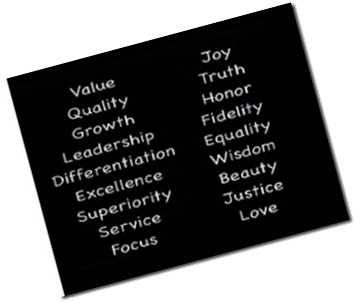
Let’s go back to Gary Hamel again.  One of his suggestions, linked to the need for ideology, was that businesses should talk the language of people (the words on the right of the slide I’ve attached above).  So yes, HR can gain a certain level of credibility from speaking the language of business – measuring everything in financial terms and using all the word on the left.  But to gain real credibility, and much bigger impact on business, HR business partners (at whatever level) need to think about influencing the business – measuring more of the business in human terms, and using the words from the right.

So, when did you last talk about joy, honour and beauty in your organisation, and if you don’t do this, isn’t it about time you start?


Also see my previous posts on the language of people:


And those leading up to this post:


You can also find out more about this approach, and other aspects of effective business partnering on my Getting to Groups with Business Partnering course delivered for Symposium Events.


  • Consulting - Research - Speaking  - Training -  Writing
  • Strategy  -  Talent  -  Engagement  -  Change and OD
  • Contact  me to  create more  value for  your business
  • jon  [dot] ingham [at] strategic [dash] hcm [dot] com

.

Monday, 28 March 2011

Symposium Events: Advances in HR Measurements and Analytics


  I’ll be talking about my perspectives on measuring HR, using scorecards, and other analytical tools, as well as other perspectives and case studies around this area in these UK training sessions this year:


Advances in HR Measurements and Analytics

11 May 2011 – Manchester
6 July 2011 – Birmingham
5 December 2011 – London


Learn how measures and metrics can be developed to help drive the success of your HR strategy.


Overview

Measurement is an increasingly important aspect of HR professional capability.  Good measurement can help maximise the effectiveness of HR strategy and operations, and can also help convince business colleagues that HR is managing itself in a business-like way.  However, most organisations’ approaches to HR measurement fail to capture the benefits of these opportunities.  Research also suggests that this area is one of HR’s weakest capabilities currently.

However, some organisations are learning to do more with their measures.  Advances in approaches, tools and technologies, coupled with developing experience in these areas, are allowing organisations to monitor, evaluate and improve the implementation of their HR strategies much more effectively than before.

Attend this seminar to learn how measures and metrics can be developed in a way that helps to drive the success of your HR strategy, your people and the organisation.  Learn why an HR strategy map and scorecard provide the most effective framework for developing and managing measurement within your own organisation.  And find out how to add value to these measures through the use of various analytical approaches.

 
Who Should Attend?
  • All HR practitioners with an interest in or need to improve their capabilities in measurement
  • HR staff responsible for measurement, analytics, benchmarking and reporting
  • HR technology staff.


You can sign up for these training sessions here.


  • Consulting - Research - Speaking  - Training -  Writing
  • Strategy  -  Talent  -  Engagement  -  Change and OD
  • Contact  me to  create more  value for  your business
  • jon  [dot] ingham [at] strategic [dash] hcm [dot] com

.


Strategic HR Review: Measuring HR through an HCM scorecard


  I think the best alternative to measuring HR in financial terms is to link HR activities and Human Capital outcomes of these activities to financial results through an HR scorecard or strategy map.

Note this is different to trying to put a financial measure on HR – it’s just about understanding from a strategic perspective what impacts HR is likely to have, and using this as a management tool to get better at making this sort of prediction about organisational performance.

I write about this perspective in the current issue of Strategic HR Review: “Using a human capital scorecard as a framework for analytical discovery” and strongly recommend reading this if you’re one of those 35% of HR professionals who think that HR’s greatest challenge is measuring everything in financial terms.

The article includes this quote from Jac Fitz-Enz in a recent conversation with David Creelman which I think explains the point quite well:

“When we talk about predictive analytics everyone thinks you need to be doing statistics, but that is not necessarily the case. There are two steps. First you need a logical framework or mental model, to think through what your problem is and identify the key variables. Then you may need statistics or metrics to help determine the best decision; but people forget the first part and fixate on the metrics.”


  • Consulting - Research - Speaking  - Training -  Writing
  • Strategy  -  Talent  -  Engagement  -  Change and OD
  • Contact  me to  create more  value for  your business
  • jon  [dot] ingham [at] strategic [dash] hcm [dot] com

.

Bersin: Measuring HCM in financial terms?


   Have you seen Bersin’s latest High Impact HR report?  There are a number of interesting findings in this, but the one that sticks out for me is the suggestion that the the greatest common factor shared by today’s HR leaders is measuring HR programmes in financial terms (mentioned by 35% of respondents and followed closely by delivering workforce metrics and analytics, mentioned by 26% of the sample).

Really?  Not improving engagement, creating a more compelling culture, or raising capability?  Not improving collaboration or the quality of conversation?  Not aligning organisation structures or redesigning roles to provide greater autonomy and integration?  Just measuring?


Now I’m delivering a two-day programme on HR metrics today so this isn’t a topic I’m unfamiliar with or see as unimportant.  But really?


There are a couple of things going on here for me – linked, or rather not linked!, to my previous post on HR’s POV.  And I guess the question is whether Bersin has unearthed a common POV about HCM, or whether it just proved that HR hasn’t got one?  That group-think reigns supreme?  This would be my suggestion.


I just don’t think that much of what we do in HR, or at least the parts of HR which are the most important, can be measured in financial terms.  They simply don’t have any absolute financial value, and their links to end financial value are simply to indistinct to place a financial value upon them.

This isn’t about HR’s inability to measure, lack of effective technology or the capability of HR professionals.  It’s simply about financial measures not being the appropriate units to measure what we do in HR.

Now if you’ve got a good basis to disagree with me on this, that’s fine – that’s a POV.  But if you’ve just accepted the “can’t manage what you can’t measure” mantra without really thinking this through, and without reading the cases of organisations which have changed things without measuring them, then I don’t think that is a POV at all.  It’s just following a fashion.  And the fashion in HR certainly seems to be moving towards measuring in financial terms.  But this doesn’t mean that it’s right or appropriate to do this.

What do you think?


  • Consulting - Research - Speaking  - Training -  Writing
  • Strategy  -  Talent  -  Engagement  -  Change and OD
  • Contact  me to  create more  value for  your business
  • jon  [dot] ingham [at] strategic [dash] hcm [dot] com

.

Friday, 25 March 2011

What’s your HCM POV?


  I think one of the most interesting inputs at the HCI Summit I covered recently was from Gary Hamel emphasising the importance of ideology – knowing what you believe about something in order to be able to support it through the design of your organisation and its processes and practices etc (or alternatively to deliberately not support it if your own ideology is out of alignment with that of your employer!).

I also talked about ideology during my HR 2.0 webinar recently, and am going to use it as a central focus to my Strategic HR session that I’m running today.

So I thought it was interesting to come across an update from Dave Ulrich’s RBL noting the importance of having a leadership point of view (see picture).  This is exactly the point that I’m going to be making – HR leaders in particular need to have a well developed POV / ideology about HR / HCM.  (I’m not so keen on RBL’s ‘brand’ concept.)

I think this POV idea is central to our Dave’s ‘credible activist’ competency, but it goes beyond this too.  It’s about understanding the range of options open to HR practitioners to do HR differently, and designing an HR architecture which is right for a particular organisation, rather than being based on practices which are being used elsewhere (see my post on Dan Pink at the HCI summit if you need a place to start).

Sorry HR, but your best practices normally just aren’t!


I’ll be running more sessions on Strategic HR in the UK later in the year – see here.


  • Consulting - Research - Speaking  - Training -  Writing
  • Strategy  -  Talent  -  Engagement  -  Change and OD
  • Contact  me to  create more  value for  your business
  • jon  [dot] ingham [at] strategic [dash] hcm [dot] com

.

Tuesday, 22 March 2011

Passive job seeking still high in the UK


I’ve posted several times recently to suggest that what seem like decent engagement scores being reported by some organisations and a few vendors may hide a number of potentially very significant, and growing, employment problems.

New based research from Plateau Systems seems to confirm this thinking:-

So firstly, yes, this survey also suggests job satisfaction is fairly high. In fact, 62% of the two thousand adults in Great Britain who participated in this YouGov survey suggested that they are very, or somewhat, satisfied in their current job.

There are some interesting variations within this – so whilst at the lowest end of the spectrum, only 49% of London based workers are very / somewhat satisfied, a full 73% of those not-always-so-cheerful Scots say they are similarly satisfied.

And while 62% may be high, it’s a tad bit lower than the 69% of US employees who said they were very or somewhat satisfied in s similar survey completed recently (see Plateau’s summary of this research, or John Hollon’s write-up at TLNT.com).


I’m Outta Here!

Based upon these findings, and what we know more broadly about the economy, it’s no great surprise that just 15% of people said they were actively job hunting (17% in London – and the North-West, and just 10% in Scotland – and only 8% in Yorkshire and the Humber).

But the survey identifies 72% of respondents, all currently employed, as I’m Outta Here’s: passive job seekers who would consider leaving their current job if approached with a new job opportunity.

And while 46% of people are seeking or would consider a new job to increase their salary, 27% are looking for career advancement and the same percentage say they just need a change - in fact 21% of people say they want to change their careers or professions as well as their employers.

(YouGov doesn’t seem to have asked people whether they’ve just felt used and abused, particularly over the last couple of years.)


You Comin’ Over?

It strikes me to be a pretty good time to be recruiting, particularly for people in London and the South. It doesn’t look like you’d even need to offer people huge increments over their current compensation. The main need seems to be about simply being flexible enough to give people a shot at something new.

Of course you could always try doing this with your existing workforce too. You may even create a few more I’m Stayin’ Put’s as well!


Plateau

This is the first of a series of posts at Strategic HCM sponsored by Plateau.

Plateau provides SaaS-based Talent Management solutions for developing, managing, rewarding and optimising organisational talent to increase workforce productivity and maximise operating performance.

Plateau software has been deployed by many of the world's most successful enterprises. Organisations such as GE, Royal Bank of Canada, Singapore Airlines and Thomson Reuters use Plateau to increase the productivity of their employees and partners.

Plateau delivers:

  • Scalable, flexible and secure multi-tenant architecture
  • 99.5% uptime
  • 24 x 7 x 654 support
  • Experienced experts to manage your system from implementation to ongoing support.


Contact Plateau here or call at +1 866 4PLATEAU (+1 866 475 2832) or in the UK at +44 203 1788 409.

You can also read updates from Plateau at their new blog: http://www.plateau.com/blog.


.

Thursday, 17 March 2011

The Winning Entry: Christine Kelly / HR Challenges at Brady Corporation


Brady Corp  I promised that I’d award a ticket for the Economist’s Talent Management Summit to one of the people responding to my recent survey on HR’s challenges and I’m delighted to announce that the winner of this ticket is Christine Kelly from Brady Corporation.

I managed to catch up with Christine last week and asked her about the responses to her survey.  First, just to let you know about Christine – she has been at Brady for 9 years and is HR Director for the EMEA region, leading 4 senior HR leaders and site teams across the region.  Brady Corporation is a $1.4 bn US owned company that you may not have heard of because its focus is in niche markets, with a particular focus on identifying and protecting premises, products and people (making for example safety signs, such as the green running man for emergency exit signs, high performance labelling systems and identity badges).

We started, as did the survey, with Brady’s business challenges.  This was all about achieving an ambitious business vision in a still uncertain economy.  One major theme was getting better organised as a global organisation.  Brady’s EMEA team has already consolidated its focus into three business streams, and the challenge now is working effectively and efficiently in these streams – using the right systems and technology, implementing best practice and clarifying responsibilities for processes – who does what etc.

The HR challenges fall out of these business challenges (I would write ‘of course’, but it’s not always the case!).  Brady HR’s first challenge is about culture and values – taking the temperature of the organisation during change and engaging employees in the company’s vision.  They do this in different ways but I particularly liked the use of what are called skip level meetings.  In these the Directors talk to the people who work for their direct reports (without the direct report being there) etc.

There’s also a strategy deployment process which sounded very empowering.  This starts with business leaders setting challenging goals for teams which will lead to the achievement of the company’s goals.  But then the teams are left to go away and find the best way of delivering against the objectives and will report regularly against the consequent improvement projects.

My third set of questions were around the preparedness of HR to deliver against these challenges, and it sounded as if Brady Corp’s HR teams are set up quite well for this.  Their processes still need work because of the recent change in business structure and processes etc (and because of the ongoing challenge of operating in a global way across the different languages and legal jurisdictions in Europe).

HR technology’s in a good state as Brady Corporation implemented Workday a year ago (and Christine says she can’t want to see the new additions in version 12).  They also use a performance and career system that they built themselves and which they see as one of the key things that support their way of doing business.  They’re also looking at a recruitment system, but the question is still whether they can justify a single system operating across the various countries they’re in, available in all the different languages that would be required – or whether they can meet their needs in a different way.

The capability of the HR team is good, partly because Christine’s been able to recruit her HR leaders herself, and has recruited them for the environment they’re working in – so understanding how to make business partnering work – which still seems to be a major challenge for many organisations, doesn’t seem to be an issue here.

Probably the biggest need is to focus on HR’s operating model – particularly given the high standards and expectations of their internal customers.  And here the issue is mainly about the time-lag between strategy and execution.  Christine explains this best herself in her response to my survey:

“The typical dilemma for HR is that the function must not only deliver the strategic support but must also manage a number of administrative tasks.  The requirement for lean teams, means that a high level of technology is required before the proportions of strategic and admin work can change.  Systems are, however, slow to be implemented and complex to standardise globally.  Pressure of work and demand for a responsive customer service demands that urgent, admin tasks suck up resources and this prevents the move to more strategic activities (and means that HR continues to maintain more administrative headcount, who are less capable to pick up the strategic work).  In practice, HR is not able to change its operating model quickly enough to meet the demands being placed on the function.”


I also asked Christine about the Talent Management Summit we’ll both be attending and she’s obviously looking forward to this, as in her view, in addition to the normal benefits about getting new ideas about best practice, The Economist has selected some influential thinkers, all from respected organisations for this conference - and they’ve also picked topics that are very relevant to today’s world.  I agree!


Also see my post on the results of the survey, and this one of my conversation with Matthew Hanwell about HR’s challenges at Nokia (Matthew will also be joining me at the Economist Talent Management Summit).


  • Consulting - Research - Speaking  - Training -  Writing
  • Strategy  -  Talent  -  Engagement  -  Change and OD
  • Contact  me to  create more  value for  your business
  • jon  [dot] ingham [at] strategic [dash] hcm [dot] com

.

Wednesday, 16 March 2011

Connecting HR Unconference (#CHRU 2)


  At the end of my HR 2.0 webinar, I mentioned that a good example of the sort of focus on community I’d been discussing is Connecting HR.

As with the various examples I described, there’s a technology focus to this community, particularly in our new social site at connectinghr.org, replacing our previous site and the Yammer group we’d been using.

And there’s the face to face side with our series of tweet-ups, and now our second unconference which will be held on 5th May.  If you can get to London that day it’ll be an event well worth attending.

See my previous posts on Connecting HR / the 1st unconference:


  • Consulting - Research - Speaking  - Training -  Writing
  • Strategy  -  Talent  -  Engagement  -  Change and OD
  • Contact  me to  create more  value for  your business
  • jon  [dot] ingham [at] strategic [dash] hcm [dot] com

.

Tuesday, 15 March 2011

HR Innovation webinar


   Then my next webinar will focus on innovation in HR, building on my recent comments about the ‘Big Rethink’ in HR.  You can Book here.


Technorati Tags: ,


  • Consulting - Research - Speaking  - Training -  Writing
  • Strategy  -  Talent  -  Engagement  -  Change and OD
  • Contact  me to  create more  value for  your business
  • jon  [dot] ingham [at] strategic [dash] hcm [dot] com

.