Showing posts with label Social media. Show all posts

Thursday, 5 September 2019

Intranet Now: The strategic digital workplace


I'll be speaking at IntraNet Now on 14 October. Come and see me if you can.


  • Consulting   Research  Speaking  Training  Writing 
  • Strategy  - Talent - Engagement  - Change and OD   
  • Contact me to create more value for your business  
  • jon [dot] ingham [at] strategic [dash] hcm [dot] com


Thursday, 29 June 2017

Influential HR Leaders


Thanks to CoreHR for including me in their list of 9 Influential HR Leaders You Should Follow on Twitter.

Please do! - I'm at @joningham - http://www.twitter.com/joningham 


  • Consulting   Research  Speaking  Training  Writing
  • Strategy  - Talent - Engagement  - Change and OD 
  • Contact me to create more value for your business
  • jon [dot] ingham [at] strategic [dash] hcm [dot] com


Thursday, 23 March 2017

A synopsis of The Social Organization


I have recently finsihed writing my new book, The Social Organization.

You can find out more about this at my new site I've been developing: Organisation.Social.

The site also includes a synopsis of the book if you want to find more about it now. You can pre-order the book already too.

Whilst I've been writing the book, I've not been doing much writing here. I guess that writing 100,000+ words had used up most of the words I wanted to write.

But there has been loads of interesting things happening in HR whilst I've been away and I'm feeling increasingly motivated to write about them. So I'm going to spend a couple of weeks catching up, and should then be helping you keep up to speed with developments in strategic HR as they happen.

Oh, and I'll be celebrating this blog's 10th anniversary this June too!


  • Consulting   Research  Speaking  Training  Writing
  • Strategy  - Talent - Engagement  - Change and OD 
  • Contact me to create more value for your business
  • jon [dot] ingham [at] strategic [dash] hcm [dot] com


Thursday, 14 July 2016

9 Influential #HR Leaders


Thanks to Core HR for including me as one of their Nine Influential HR Leaders You Should Follow on Twitter.

If you're not following me there you'll find me at twitter.com/joningham.

The other eight are:


  • Consulting   Research  Speaking  Training  Writing
  • Strategy  - Talent - Engagement  - Change and OD 
  • Contact me to create more value for your business
  • jon [dot] ingham [at] strategic [dash] hcm [dot] com


Tuesday, 16 June 2015

#EconTalent Glassdoor and Employer Branding


It's just after lunch and Diarmuid Russell from Glassdoor has been leading a session on employee branding in a social media world.

He kicked off by mentioning Sir Clive Woodward's suggestion from the morning that it should be everybody's responsibility to be involved in social media.  One of Glassdoor's surveys suggest:
  • 78% of people use social media as part of recruitment
  • 41% (13% of millennials) thinks it is important to stay in a job for at least 5 years
  • 77% of millennials value culture and fir with prospective employer
  • 76% of people change their perception of an employer when it is actively involved in responding to comments.


Most people in the room suggest they do check their company reviews on Glassdoor, though Diarmuid still explained it for at least one attendee who didn't know what it is.  Basically it's about putting the power to make decisions about employment into the hands of the people - based on the fact that people today trust the opinions of people like them rather than experts and company websites etc.  In fact two thirds of applicants are more sceptical about claims made by employers than they were three years ago, and that rises to 65% for millennials.

This supports the increasing focus on transparency implicit in Glassdoor founder's three laws of the web:


We also looked at Brandon Hall's definition of employer branding as a combination of reputation and image.

  • Image - an employer's public portrayal of the various elements of its unique employee value proposition - from the language used in job postings and advertisements to the message conveyed by recruiters across various channels and mediums.
  • Reputation - the combined sentiments of candidates, employees, customers and clients (past, present or future) regarding an organisation's viability as an employer of choice - usually (but not always) based on first-hand experience.


In todays' environment of transparency, Glassdoor helps employers manage, or at least inform, their reputations, which together with image provides the employer brand.

Glassdoor also supports employer branding through a free employer account, providing great analytics for companies:


Also see my first post from the conference: Charlie Mayfield on digital talent challenges


  • Consulting   Research  Speaking  Training  Writing
  • Strategy  - Talent - Engagement  - Change and OD 
  • Contact me to create more value for your business
  • jon [dot] ingham [at] strategic [dash] hcm [dot] com


Tuesday, 17 September 2013

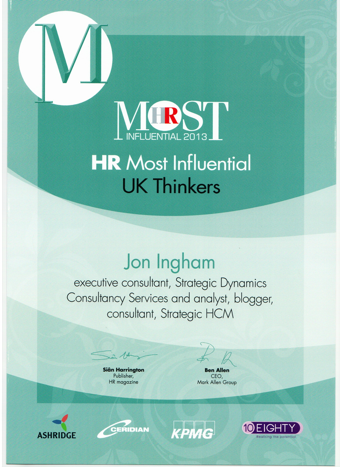
#HRMI 7th Most Influential

HRMI.png

Another great evening at HR Magazine's Most Influentials last night, and I was pretty pleased to come in 7th position in the UK Thinker list.

I was especially pleased with the leap up the chart given I've not been blogging or tweeting that much recently.  So I think the recognition is largely for my consulting, training and speaking etc, rather than what I do here.

And actually I've never really had that strong a social media presence outside my blog - e.g. my Klout is currently just 55 - well below many of the social media super users and quite a few other people too!

What was interesting though is that the many of the top three in each category - UK thinkers, international thinkers and practitioners - are on social media now.  Eg the top UK thinkers are all on Twitter now:

#3 Adrian Furnham - @profAdrianFurnh (on, but now using it)

#2 Cary Cooper - ProfCaryCooper - Klout = 60

#1 Peter Cheese - Cheese_Peter - (new to Twitter and not being rated yet)


And the new Lifetime Achievers:

Will Hutton - @williamnhutton - Klout = 48

Lynda Gratton - @lyndagratton - Klout = 51


So, I'd support my previous advice that HR people wanting to be influential should be on social media.

However, I'm not sure about the rest of this advice.  I had suggested that the old guard were going to get thrown out, and thew new lot would be social mediaistas.  I don't think that's going to happen now. 

Instead, it's existing influencers who are taking to social media to extend their influence, in the way I had suggested.  And it's these influencers who are continuing to influence HR - not the social media using twitterati.

Sorry - i got this one wrong but I still believe most of the things I try to influence HR around are right!!!


Anyway, I'd like to take the opportunity to thank those HR Directors who put me on the list.  And remember, you can also recommend me on Linked too!


  • Consulting - Research - Speaking  - Training -  Writing
  • Strategy  -  Talent  -  Engagement  -  Change and OD
  • Contact  me to  create more  value for  your business
  • jon  [dot] ingham [at] strategic [dash] hcm [dot] com


Technorati Tags: , , , , , , ,

Monday, 21 January 2013

Google Plus - Social HR, Engage for Success

Screen Shot 2013-01-21 at 22.02.11.png  i've been finding it hard to return to blogging after the Christmas break.  That's nothing that unusual - I quite often end up having a few weeks off and then gradually feeling a renewed commitment to post.  Though I will say that there has been a particularly long gap this time around.

To some extent this is down to my latest shiny new toy.  That's Google Plus, or more specifically, Communities over at Google Plus.

I don't often write about social media here.  I'm much more interested in the social impacts of these tools than I am the tools themselves.  So apart from Blogger and Twitter, I don't use any other tool that much.  I've never found Facebook that compelling and though I've got lots of contacts on Linked, I'm not on there that much (particularly with the removal of Events and Answers, which I thought were some of its best features).

But I really, really like Communities on Google Plus.  In fact I really like Google Plus, but prior to Communities hadn't found anything that made me want to spend time there.  I tried a few Hangouts / Hangout On Airs which I still want to experiment with, but my efforts towards the end of last year weren't very successful.

But Communities are great.  They're easy to use, nicely formatted with link pictures appearing automatically and I just find them much more compelling than groups on Facebook or Linkedin, or even Twitter.

Added to that you've got potential benefits supporting AuthorRank, linking back directly to what's still going to be the world's leading search engine, so it's a good place to be spending time contributing.

I'm spending most of my time in two communities that I'm also moderating:


  • Social HR is growing quickly - 428 people as of today - and consists of a mix of posts about different aspects of HR, and some discussions about what social HR involves.


  • Employee Engagement is a community I'm co-moderating together with other members of the Engage for Success movement.  It's growing more slowly but we're having some interesting conversations there, and once again, I personally fin it a much more compelling place to be than the movement's existing Linkedin groups.  I'm sure that over time the conversations will slowly move to the Google Plus group.


Do have a look at Google Plus, Communities, and both Social HR and Employee Engagement if you've not been over there before - it'd be great to see you.

Though I will soon be getting going posting here again too.


  • Consulting - Research - Speaking - Training - Writing
  • Strategy - Talent - Engagement - Change and OD
  • Contact me to create more value for your business
  • jon [dot] ingham [at] strategic [dash] hcm [dot] com


Technorati Tags: , , , , ,

Friday, 14 December 2012

People Sourcing Certification Programme


   I’ve had a long standing interest in the field of sourcing (finding people who might be a good fit in your organisation / role vs recruiting – trying to get these same, but unknown people to send you their CVs), really ever since we developed the idea into an approach we called head farming when I was an HR Director at Ernst & Young.

Though head farming was horribly expensive, social media makes the same sorts of approaches straight forward, eg this case study from Coca Cola, but still requires a good level of skill.

And I’ve sort of thought I know quite a bit of what I need to in this area (or quite a bit of what you need to, since I’m not actually a sourcer or recruiter, but I still want to understand it to show you what you’re missing out on.  And actually I still use the approaches in various other applications – eg finding business prospects.  I’d almost suggest it’s becoming a core skill that everyone should be taught at school in today’s networked world.)

That’s until I tried Irina Shamaeva’s international people sourcing contest a couple of month’s ago.  And…  err…  well, I realised I didn’t know quite as much as I thought I did (basically, I didn’t have a clue.)

So, I’m currently setting out doing some initial self-study (I might post more about this in early January) and will be attending Irina’s People Sourcing Certification Program on, and following on from, 29 January.

Again, I’ll give you a taste of what I’m learning around then, but if you really want to understand sourcing, and how to do it, why not take the programme too?


  • Consulting - Research - Speaking - Training - Writing
  • Strategy - Talent - Engagement - Change and OD
  • Contact me to create more value for your business
  • jon [dot] ingham [at] strategic [dash] hcm [dot] com


Monday, 3 December 2012

Speaking at SHRM Annual Conference


   I’ll  also be speaking about social media at SHRM’s annual conference in Chicago next Summer.  Actually, my session won’t just be about social media, but all of the various elements of an organisation that help us develop its social capability.  Social media is the newest of these enablers, and in some situations it’s likely to be the most important, but many of the other tools we have at our disposal have the potential to be even more impactful.

My proposal was actually a response to reading the tweets and blog posts about Malcolm Gladwell’s session in Atlanta last year.  I love Gladwell’s thinking, but I didn’t think he linked his inputs to the activities HR already understands, or the social technologies with which it is becoming increasingly comfortable.  So I wasn’t sure that HR practitioners would be able to maximise the opportunities that social network design provides.

So I wrote:

“Malcolm Gladwell has introduced SHRM attendees to the importance of networks and social organisations as opposed to hierarchies. Many are now conversant with social media. But these are just a couple of the many tools available to HR to redefine its focus.

The point of performance in most organisations has for a long while been the team. And increasingly, this focus is being supplemented by the increasing importance of communities and networks too. So why is it that most of what we do in HR focuses on individual – their engagement and capability etc, and on whole organisations – structure and processes etc. Why don’t we focus more on the white space between these levels – the relationships between our people?

These relationships are important. The value of relationships, or social capital, potentially provides the largest and most untapped source of competitive advantage within a resource based strategy (which is also increasingly being seen as the main opportunity for competitive success as opposed to strategic positioning or the use of core competencies).

Increasingly, organisations are attempting to influence their peoples’ relationships, mostly through the use of social media and networking (enterprise 2.0). These efforts are typically led by IT. However, the success of these tools depends on effective behaviour and cultural change and hence this really falls within HR’s remit. In addition, many more traditional tools from HR’s kitbag can be used to develop social relationships. These include team based HR activities, facilitation, organisation development, community focused leadership development, workplace design etc.

The key need is not simply to use all the potential tools but to shift HR’s focus onto this new agenda – using social networks and technologies to enable social capital – this is the New HR.”


And I’m on:


I hope I’ll get to see you there!


  • Consulting - Research - Speaking - Training - Writing
  • Strategy - Talent - Engagement - Change and OD
  • Contact me to create more value for your business
  • jon [dot] ingham [at] strategic [dash] hcm [dot] com


Friday, 19 October 2012

#E20S - Social HCM?


   There’s a new term in town – social HCM.  Or so it would seem….

It might just be coincidence of course, but I recently received a press release about a UK based system called Fairsail, linked to the USA’s HR Technology conference last week.  Of course many HCM systems are already quite socialised (see this post) and Saba branded itself the people collaboration system for a while, but this is the first time I’ve seen one describing itself as a Social HCM system.

Then I got a Facebook invite to discuss Social HCM with Bjoern Negelmann who runs the European Enterprise 2.0 Summit in Paris and which has led onto a Google + Hangout discussion I was supposed to talk at on Wednesday, but unfortunately didn’t manage to make (actually it’s a Hangout On Air which means you can watch the archive on Google / YouTube too).

So what is this thing – social HCM? Well you can see Bjoern’s thoughts here.  As usual, I have a rather different take.  One of my beliefs about HR – taken from Dave Ulrich – is that we need to focus much more on outcomes than we do on activities.  This 1. makes us more strategic as we avoid investing in activity for activity’s sake; 2. makes us more credible as people who deliver things are always viewed more highly than people who do things; 3. gives us a chance to take accountability for the outcomes we produce; and 4. gives us more opportunity to create value by taking these outcomes to our business colleagues as things we can deliver which will help the business improve, rather than just talking about how we can support the business to do what it already needs to do (ie moving from adding to creating value).

It’s why I define HCM as managing people to create human capital – activity to provide an outcome.

So what’s social HCM?

There are probably three possibilities.  The first is doing HCM – or probably more realistically HR – in a social way (activity).  As Bjoern suggests, this might be about being more open, co-creating, collaborative etc.  These are great approaches but this still leaves the door open for following these approaches for their own sake.  Also I’m not convinced that all organisations need to use them.  And I expect that those who believe most organisations are going to become highly open, co-creating, collaborative are being overly optimistic.  I can’t see it happening, and don’t necessarily think it needs to anyway.

The second possibility is focusing on creating human capital through social approaches (a mix of activity and outcome).  For example trying to raise employee engagement by creating a more collaborative environment, as most people – though not everyone – would agree this is one of the major engagement drivers for employees around the world.  This is good too, but is really just an aspect of HCM – I’m not sure there’s enough to justify a new name for it.

And the final option is about creating social human capital (outcome) – which you can just call social capital really – so social capital management (SCM) then, ie the management of people to accumulate social capital.  The problem with this is that you can’t really do this – ie manage people to create this outcome.  You have to lead and enable them instead.  (Actually the same thing applies to HCM but the requirement is even more pronounced with social capital – and the dissonance associated with calling it SCM therefore that much greater too).

It’s the third of these options which excites me, and I’d suggest organisations, their HR functions and Enterprise 2.0 practitioners need to think about.


Also see my posts from the E2.0 Summit last year:


  • Consulting - Research - Speaking - Training - Writing
  • Strategy - Talent - Engagement - Change and OD
  • Contact me to create more value for your business
  • jon [dot] ingham [at] strategic [dash] hcm [dot] com


Wednesday, 10 October 2012

Too much communication at #MelcrumSummit

information-overload.jpg    The next two presentations this morning have been from Rebecca Edwards at GE and David Harrington at Shell - both good case studies with similar themes. 

The main topic for me is about too much communication - meaning that the goals for Internal Communication practitioners shouldn't be to communicate more.

Take these stats for example:

  • 91% of US workers discard work information without fully reading it (and the other 9% are just lying!)
  • 65% of Uk employees state their work is negatively affected by the amount of data they receive
  • The total cost to US companies annually of interruptions caused by information overload is $650bn (not sure if this is a US or a UK billion)
  • The total cost to UK companies of searching online for information someone saw but then cannot find is £120 per person every two weeks (this is a big one for me personally)


Shell have 6000 users of their corporate social network, Q&E and 1372 articles were posted in June but 74.3% received less than 100 views.

David Harrington showed a nice video of a Shell employee being served a succession of foods which acted as a useful metaphor to the way we often try to communicate, communicate, communicate (it also brought back fond memories for me of sponge puddings in the Shell Mex restaurant when I was working there 20 years ago.

They're trying to change behaviour by focusing on measurement, including this rather nice social engagement index:


 DSCN4815.jpg


David is big on measurement, in fact for him, if you can't measure something you shouldn't do it!  (NO - see these two posts for why: 1, 2).  This also provided an interesting contrast to Anne-Lise Kjaer's perspective that measurement is sooo 20th century! - a difference which unfortunately we didn't get a chance to explore.


GE try to tailor their communications (to potentials and alumni as well as current employees) according to age, gender, culture and ability etc.  One interesting thing they do is to allow members to opt-in to particular communications.


  • Consulting - Research - Speaking - Training - Writing
  • Strategy - Talent - Engagement - Change and OD
  • Contact me to create more value for your business
  • jon [dot] ingham [at] strategic [dash] hcm [dot] com


Technorati Tags: , , , , , , , ,

HR, IC, social technology and the We society

DSCN4814.jpg  Today is going to be a busy blogging day as I'm at the Melcrum Summit for some inputs on internal communications from GE, Shell and a range of other companies (Rebecca Edwards from GE has just been talking about the 'lots of conversations' they needed to have HR to open their internal communication site, http://ge-works.com out to the public.  I take it these were difficult conversations so not the greatest start to what I was hoping would be evidence of growing integration between HR and IC!).

But we've started with Anne-Lise Kjaer.  Now I wasn't going to post on her -  firstly because I already have, and secondly because I've been thinking about some things I've been reading about what's been going on at the US' HR Technology conference in Chicago and have been wanting to post on these.  But actually I think they're pretty much the same thing. 


So the main point I wanted to comment on from the HR Tech conference is about the integration between HR and social technologies.  I liked the post from Yvette Cameron arguing that HR needs to be more interested in social technologies like Atlassian, Jive, NewsGator, Socialtext andTelligent.  I agree!  That's why I've been attending and speaking at a range of Enterprise 2.0 conferences in US and Europe over the last five years.

However I don't agree with Yvette's reasoning for why we (HR, and IC too I guess) should be interested i.e. that these systems are having increasing impacts on 'social HCM' e.g. social learning and social talent management.  Well yes, they are, but that's still not the reason why these systems are so interesting.

The bigger reason is that these tools are changing the way organisations are working.  Companies are becoming more social and HR needs to lead this change.  So we need to understand and get involved in how our companies are using social technologies too.  This is what I think Marcia Connor will be talking about at HR Tech later on today.  (And well done to Yammer for being at both HR Tech and the Melcrum Summit today.)


But there's more.  And this is why I've changed my mind and want to comment on this morning's speaker too.  Anne-Lise made a very powerful case for why we need to broaden out our thinking - from logical to emotional, and from me to we i.e. that we're now living and working in a we society, not a me society (see her slide if you can read it).

This is the bigger shift for all of us - HR, IC, HR tech, Enteprise 2.0 etc etc etc.  It's transforming our organisations into true social businesses, through the use of technology, but also by adapting and updating our processes, changing our leadership models, redesigning our workplaces - lots of different things.  I still think we should be seeing more of this agenda at HR, HR tech, IC, IT conferences and beyond.  I'm certainly going to do what I can to continue promoting it from my end!


Also see:


  • Consulting - Research - Speaking - Training - Writing
  • Strategy - Talent - Engagement - Change and OD
  • Contact me to create more value for your business
  • jon [dot] ingham [at] strategic [dash] hcm [dot] com

.


Technorati Tags: , , ,

Thursday, 2 August 2012

More on Social Media in HR Summit


   I’ve received an update on the programme for Fleming Europe’s Social Media in HR Summit taking place on 27th and 28th September in the ‘internet capital of Europe’: Dublin, Ireland (base for international headquarters of companies such as Google, Facebook,LinkedIn, eBay, Zynga, Twitter and Gala Networks).

Confirmed sessions / speakers now include:


  • From Traditional Recruitment to Web 2.0 Recruitment..., Alfredo Donati, HR Partner and Recruiter,  Lufthansa, Ireland


  • Philosophy of Recruitment 3.0, Matthew Jeffery, Head of EMEA Talent Acquisition and Global Talent Brand, Autodesk, UK


  • Sustainable Social Media Recruitment Strategies - ...or how to prevent your strategy from failing after 3 months, Ted Meulenkamp, International Program Manager, Employer Branding and Social Media Recruitment, Hoffmann-La Roche, Spain


  • The Human Face of Your Organization, Jean-Marc Mickeler, Partner and Head of Employer Branding, Deloitte, France


  • Exploring the Future of Talent Acquisiton, Christoph Fellinger, Talent Relationship Management, Beiersdorf, Germany


  • Expanding and Enriching your Social Media Footprint, Stephen Jio, Social Media and Community Professional, Dell, Ireland


  • From Best Practice on Earth to Best Steps forward in the ’Cloud’, Courtney Shelton Hunt, Founder, Social Media in Organizations (SMinOrgs), USA


  • Legal issues to be aware of “Rules of Befriending” on FACEBOOK, Dan Manolescu, Protection and Privacy Advisor, European Commission (Data protection Officer‘s Office), Belgium, Data


  • How Individual HR Professionals can and should use Social Networks and Digital-Virtual Technologies, Carrie Corbin, Associate Director of Strategic Staffing & Talent Attraction, AT&T, USA


It looks like a great event and I’m looking forward to catching up with Matthew Jeffery again and meeting all the other speakers – particularly Courtney Hunt as I’m in her SMinOrgs groups and we have tried to get together before – particularly in a joint proposal for a presentation to the US’ Enterprise 2.0 conference which unfortunately didn’t happen. So it’ll be good to team up for this.

And I hope I’ll also get to meet you there too?

If you’d like to attend the event you can book at http://human-resources.flemingeurope.com/social-media-hr/register.


  • Consulting - Research - Speaking - Training - Writing
  • Strategy - Talent - Engagement - Change and OD
  • Contact me to create more value for your business
  • jon [dot] ingham [at] strategic [dash] hcm [dot] com

.

Friday, 13 July 2012

Sosialhjelp 2.0


   Another event later on this year that I’m particularly looking forward to is PersonalForum organised by HRNorge in Tonsberg, Norway in November.

I’ll be doing a workshop – possibly on HR measurement – and a keynote on HR’s role in the social business.  More details here, or in English below:

“The organization's use of social media is HR's responsibility, says Jon Ingham. There is a wealth of possibilities in 2.0 organizational development. Why does he do it? The answer he gives on the Human Forum 2012. Jon Ingham has been suggested as one of the 25 most prominent thinkers in HR, and some also have designated him “the next Ulrich.”

Ingham is mildly critical of two important trends in HR. The strong focus on HR must get closer to the business means that we risk losing some of what makes HR value - the human side. In addition, he points out that the focus on performance measurement may be too strong. "When performance measurement is performance monitoring culture will suffer", therefore it is important that HR work more relationship-oriented, says Ingham.

He believes that HR has much to gain from being more relationship-oriented, and here comes the social media.

HR technology is an area where there are extraordinary opportunities to create new values ​​of HR, says Ingham. At the same time they are used in special processes such as recruitment, training and internal information. Through social media based business network that can prove to be valuable, for example in recruitment. It is about using technology to develop new and deeper relationships that business can take advantage of in order to attract the very best.

After recruitment, it is internal communication and training that is the most common use. Social learning is more effective and it can be done through informal conversations with each other or training of the teams and larger groups. Collective intelligence is not about information flows and processes that are supported by social tool - it is about giving people autonomy to make faster and better decisions with the help of social relationships.

The blog "Top 100 influencers" quotes Einstein in his presentation by Jon Ingham:

For every 250 blogs that speaks out in an empty virtual room for nothing, it's a voice that delivers value and perspective. The democratization of publishing technology has made it possible for all kinds of voices to be heard. The fact that so little is actually said is a problem only if you do not agree with Einstein, who said that "only two things are infinite, the universe and human stupidity - but I'm not sure what is the universe."

In other words: The ability to deliver social media is absolutely no guarantee of quality. Or success.

But Ingham has success, and he has made it even through his blog), and later with the book "Strategic Human Capital Management: Creating Value Through People".

The Human Forum 2012, Ingham to talk about how HR is now increasingly use social media to support their own processes. How will HR in a more efficient way to facilitate relationships and expertise effectively 2.0 business must have.

Jon Ingham, is a British HR blogger, author and Top 25 HR Thinker in the United Kingdom 2011. The Human Forum 2012, you can hear him lecture "Social media in the business - why it's HR's role."

Read more about Personal Forum 2012 and register here.’


  • Consulting - Research - Speaking - Training - Writing
  • Strategy - Talent - Engagement - Change and OD
  • Contact me to create more value for your business
  • jon [dot] ingham [at] strategic [dash] hcm [dot] com

.

Thursday, 12 July 2012

Social HR Camp


   We’re half-way through the Summer now (even if it does feel as if we’ve not actually got started with it yet) – they’ve even started selling tickets for Hyde Park’s Winter Wonderland today - and I’m starting to think about some of my key events for Autumn.

There’s no ConnectingHR unconference this Autumn, at least not at the Spring, but another HR unconference – Social HR Camp - will be here in Europe – in Amsterdam on 24th October, just before HR Technology Europe, and shortly afterwards in Dublin on 31st October:

About Social HR Camp

SocialHRCamp explores how Human Resources professionals around the world can leverage social media to create and generate unparalleled business value.  This is not a typical conference where you spend most of your time being spoken at.

SocialHRCamp allows YOU to be an active participant in shaping the “UnConference”—be as active as you want to be.  From passive audience member to leading a session on a topic related to HR and social media, the experience is yours to create.

Social media is not a fad—with 800 million+ Facebook users, over 175 million Twitter users, 4 billion YouTube views every day, and the impact of other platforms like LinkedIn, Pinterest, Google+ and many more, the opportunity for HR to tap into this audience is enormous.

Whether you’re new to social media or an expert, SocialHRCamp is for you.  You will be able to customize your Camp experience based on your skill level—beginner, intermediate and advanced.  Not only will you learn from others, you will have the opportunity to collaborate with your peers and showcase your talents and interests in an impactful way.


This unconference has another different format from TRU, ConnectingHR, HREvolution etc and should be a really good social learning event.  I’ll be track leading at both events and it’d be great to see you there, and I imagine I’ll be busy posting from the events as well.


  • Consulting - Research - Speaking - Training - Writing
  • Strategy - Talent - Engagement - Change and OD
  • Contact me to create more value for your business
  • jon [dot] ingham [at] strategic [dash] hcm [dot] com

.

Friday, 29 June 2012

CIPD: Harnessing Social Media for Organisational Effectiveness


   I’m included in a new report from the CIPD on HR’s use of social media, which is currently being used as an incentive for people to renew their memberships.  This means that I can’t point you at the research, but you should be able to read the comments on the report from a couple of the authors:


I refer to my interest in social media, and social outcomes, at the beginning of this article:

“In my piece in the CIPD report ‘Harnessing Social Media for Organisational Effectiveness’ I focus on social capital and the opportunities social media provides to create this type of people-related outcome. I thought it might be useful to post here about why I think this is an important focus.

In particular, some people who know me, or read my blog etc, may be surprised by my suggestion in the report that social capital is probably a more important focus than human capital. After all, I am mainly known for my strategic thinking on human capital management (Strategic HCM).”


I was also talking about this yesterday in a session on learning and development earlier this where I suggested that social learning is important partly because it’s a more efficient and effective way to learn (activity), but also because it’s the only possible way – vs individual learning – to develop a learning team, community or organisation (social outcome).


(ie social learning is the only form of learning which directly produces social capital.)


I’m really pleased this perspective on HR’s use of social media is starting to become better understood – does it work for you too?


  • Consulting - Research - Speaking - Training - Writing
  • Strategy - Talent - Engagement - Change and OD
  • Contact me to create more value for your business
  • jon [dot] ingham [at] strategic [dash] hcm [dot] com

.

Monday, 18 June 2012

#ECTalent – Net Gen Leadership


   I’ve already posted on some of the morning session’s from last week’s Economist Talent Management Summit.

After lunch I was due to moderate a panel featuring Ryan Blair but he didn’t show up, so Lucian Tarnowski stepped into Ryan’s shoes, I stepped into Lucian’s, and Robert Guest, the Economist’s business editor stepped into mine.

The session was designed to consider how organisations can build, manage and retain leaders from gen y / the net generation who are more mobile and eager to self-develop than any previous group.

I’d have enjoyed moderating the discussion but didn’t feel so comfortable inputting - as you can probably tell from the photo, I’m largely unconvinced by a lot of what is talked about gen Y (or in Lucian’s terms, Gen Why?).

In my view, and experience, there definitely is something about gen Y which is different from other generations, and isn’t just about their stage of maturity.  But many of these characteristics are shared by others outside of this population (desire to make a difference, propensity to collaborate, use of social media etc – me, me me!) – it’s just that gen Y are showing these characteristics earlier on.

Eg when I was a junior consultant at Andersen Consulting (Accenture) I had one Partner who made me stay late in the office, sometimes standing up my friends to do so (this was in the days before mobiles)*.  I don’t think gen Y employees would put up with that today and nor should they have to.  However, I do sometimes think that they’re lucky to live in the times that they do.

I also think we have to be careful about talking about gen Y as a global category.  Due to social media etc, gen Y may be more similar around the world than previous generations, but they’re definitely not the same.

I also believe that a lot of gen Y’s more narcissistic tendencies have been reshaped by events over the last couple of years.  Eg, and I felt a bit exposed saying this sitting next to the man from the Economist, but I risked sharing statistics on Greek and Spanish youth unemployment (both over 50%) to suggest that in many ways this is the new lost generation and that they’re not that lucky at all (and we haven’t even begun to consider the state of the planet that Doug Baillie mentioned).

A generation’s characteristics may be mainly shaped by the experience during their teenage years, but you don’t live through the shocks of the last half decade without it leaving an impact on you, whatever age you are.

We also talked about social media and I referred participants back to Doug’s points on the crisis of leadership – if HR leaders want to understand more of the characteristics of the net gen / gen y then registering with Twitter would be a great place to start!**


Also see:


* Gary Kisler – I’m talking about you!!!

** OK, OK, I know this isn’t where gen y tend to hang – but it’s  better place than most to experience what social media is really all about.


  • Consulting - Research - Speaking - Training - Writing
  • Strategy - Talent - Engagement - Change and OD
  • Contact me to create more value for your business
  • jon [dot] ingham [at] strategic [dash] hcm [dot] com

.

Wednesday, 13 June 2012

HR Technology Europe


   The other conference this Autumn with a big focus on social media will be HR Technology Europe which I’ll be chairing for the second year.  On the main stage, amongst other speakers will be:

  • David Hernandez, Société Générale
  • James Purvis, CERN
  • Nalin Miglani, Tata Global Beverages
  • Anthony Shaw and Simon Linares, Telefonica Digital
  • Roel Dumont, Tessenderlo
  • Mark Martin, Direct Line
  • Thomas Otter, Gartner
  • Sarah White
  • Josh Bersin
  • Naomi Bloom.


And as well as the main technology conference , there are several different break-out shows including ‘Social Enterprise’ moderated by Stowe Boyd and featuring Luis Suarez from IBM, Andy Boyd from Shell and Nicolas Rolland from Danone.


There’s also ‘Next Gen Talent’ which includes Nick Holley from Henley arguing that most talent management is an irrelevant and Heiko Fisher on why your company should look like a Burrito!


The dates are 25 & 26 October, it’s at the RAI in Amsterdam and I hope that I’ll see you there.


  • Consulting - Research - Speaking - Training - Writing
  • Strategy - Talent - Engagement - Change and OD
  • Contact me to create more value for your business
  • jon [dot] ingham [at] strategic [dash] hcm [dot] com

.

Tuesday, 12 June 2012

Social Media in HR Summit, Dublin, Ireland


   I’ve recently arranged to speak at another couple of great conferences over the next few months.  On Thursday 27th / Friday 28th September I’ll be speaking at Fleming Europe’s Social Media in HR Summit held in Dublin:


How to leverage social media properly?

Are organizations exploiting social media to reach external audiences?

Who is using social media in the workplace?

Do organizations provide any social media training to employees who engage in social media activities?

These are only a few questions that were asked in the SHRM Survey 2011: Social Media in the Workplace. The results were rather startling. They revealed that while 68 % of organizations leverage social media to reach external audiences, only 27 % of them provide employees with training on how to work with social media.

Are you among them? Are you looking for a change?


At this one-of-a-kind event participants will meet highly qualified experts from Microsoft, Deloitte, LinkedIn, Twitter, Nokia, Orange, Ford, Unilever, Vodafone, Dell, Samsung, HSBC, etc. These forward-looking, top-level enthusiasts working in the strategic communications industry and new media will focus on the importance of embedding digital thinking and social media impacts in HR practice.

In order to bridge the gap between the necessary and real-life practice we have chosen topics including social engagement, recruitment futurology, digital networks, social media footprints, risks and exploitation of social media strategies and much more.

Fleming Europe's premiere cross-industry HR event is aimed at Senior Executives responsible for Talent, Recruiting, Knowledge Management, Employee Engagement and Learning as well as Communication Executives responsible for Employer Branding, Internal Communication and Social Media.

Are you interested in exploring the most 'viral' social network issues? Do you want to seize the opportunity to gain valuable contacts and useful information? Then do not hesitate and join us in Dublin. Learn more at http://cross.flemingeurope.com/social-media-hr/


I hope you can join me there.  And I’ll be live blogging from the event here too.


  • Consulting - Research - Speaking - Training - Writing
  • Strategy - Talent - Engagement - Change and OD
  • Contact me to create more value for your business
  • jon [dot] ingham [at] strategic [dash] hcm [dot] com

.

Monday, 21 May 2012

Middle East HR Summit


   I’ve got more great conferences coming up later in the year.  One of these I’m really looking forward to is IIR’s HR Summit in Dubai in November.

Dave Ulrich kicks the conference off with a full day on HR from the outside-in and leadership (the why of work).

The rest of the programme is the split into sections based upon Ulrich’s HR competencies.  You may remember that one of these is ‘technology proponent’ and I’ll be presenting on social media in HR, and HR’s role in supporting the use of social media in business.

I’ll then be wrapping the programme up with a workshop on HR measurement.


Other speakers include:

  • Christel Heydemann, EVP Corporate Human Resources & Transformation, Alcatel‐Lucent, France
  • Ehab Hassan, Group Chief HR Officer and Executive Vice President, National Bank of Abu Dhabi, UAE
  • Hussain Al Obaidly, Chief Human Resources Officer, Mubadala – GE, UAE
  • Thomas Bartridge, Director of Human Resource, Masdar, UAE
  • Wayne Davies, HR Director – Middle East, North Africa and Turkey, GE, UAE
  • Craig Deaves, Organisational Capability Manager, BP, Iraq
  • Maryam Al Falahi, HR Consultant and Former VP ‐ HR Strategy & Planning, Etisalat, UAE
  • Maha Al Mansouri, Associate Director – HR and Emiratisation, Masdar, UAE
  • Cora Koppe‐Stahrenberg, Chief Human Resources Officer, Emirates Investment Authority, UAE
  • Akif Tashkandi, HR Director, Boeing International, Saudi Arabia
  • Jalal Al‐Khaled, Chief Human Resources Officer, Abu Dhabi National Insurance Company, UAE
  • Salwa Al Nuaimi, Vice President Talent Acquisition, Etihad Airways, UAE
  • Charlie Sampson, Former Regional Head of Talent Management, HSBC Bank, UAE
  • Othman Haddi, Associate Director, CEEMEA HR Headquarters, Procter & Gamble, Switzerland
  • Tamer Elewa, Regional HR Business Partner ‐ Global Operations, Merck Serono, UAE
  • Jonathan Budden, HR Business Partner, Microsoft, UAE
  • Dilpreet Singh, HR Leader ‐ Middle East & Africa, IBM, UAE
  • Salem Baabdullah, General Manager ‐ Talent Management, Saudi Arabian Airlines, Saudi Arabia
  • David Capozzalo, Lead ‐ Executive Leadership & Development, SABIC, Saudi Arabia
  • Veronica Munro, Head of Leadership Effectiveness – West, Standard Chartered, UAE
  • Matthew Mee, Vice President – Human Resources, Jumeirah Group, UAE
  • Colin Gow, Group Head of HR Shared Services, Al Futtaim, UAE
  • Khaled Helaly, Director ‐ Strategy and Business Planning HR, Qatar Foundation, Qatar
  • Indi Seehra, Director of Human Resources, University of Cambridge, United Kingdom
  • Khalil Cotran, Managing Director – Human Resources, NBK Capital, Kuwait
  • Assaf Al‐Quraishi, Vice President ‐ Human Resources MENA, Unilever, UAE
  • Lee‐Anna Nussbaumer, Corporate Director of Human Resources, Emaar Hospitality Group, UAE


If you’re in the region I hope I’ll see you there.


  • Consulting - Research - Speaking - Training - Writing
  • Strategy - Talent - Engagement - Change and OD
  • Contact me to create more value for your business
  • jon [dot] ingham [at] strategic [dash] hcm [dot] com

.