Tuesday, 12 April 2011

#HRD11: Questioning not Solutioning


  One of the points the CIPD was stressing was that HR needs to adapt to the situation it exists within (I agree).

Lucy Lewin from Standard Chartered talked about the need to hold yourself in a place of anxiety a little longer than usual, and to consider all the data – including on leadership, engagement, shared services usage, the voice of the customer etc – and how you physically feel as that’s a data point too (I agree).

This is about remaining in a state of questioning, rather than what Lucy called, rather clunkily, solutioning.

I think this is right.  HR tends to be too eager to grab hold of the next easy solution.  And there were a few examples of this type of thinking at the conference unfortunately.

For example, I liked John Seddon’s emphasis on systems thinking and frequently use this approach to help ask better questions myself (I also wrote extensively about systems and complexity based approaches in my book on strategic HCM).  But to suggest that systems thinking implies that companies should always take an outside-in rather than a top-down perspective looses the value of questioning, and tries to impose a solution which may or may not be appropriate in a particular situation.

I’d even make the same criticism about one of my favourite companies, HCL (see this post and others linked from it based upon my meeting with HCL’s CEO, Vineet Nayar, last year).

Employee First Customer Second is a great example of a people centred, innovative (next generation) approach so I really enjoyed meeting Anand Pillai, HCL’s Head of Talent Transformation before the show.  In fact I much preferred our meeting to the conference presentation as I didn’t think this reflected what makes HCL such a special organisation – their career and succession planning processes seem quite traditional to me (albeit perhaps being implemented with a bit more passion than elsewhere) but I think succession should really be a completely different concept when your organisation is placed upside down!

Our pre-show meeting absolutely did cover some of HCL’s more special ideas but we also talked about the change we need to see within HR.  Pillai’s not from the HR function and I don’t think he’s our biggest fan.  And he’s got a point when he says that HR is often an organisation’s most hated function; that it tends to do a lot of HR for HR; and says no too often - but I think that’s changing too (as the case study organisations I covered in my last post show).  And the sorts of changes that Nayar and Pillai have implemented are what HR is increasingly doing now.

But for me, Employees First is only one example of the variety of approaches to people management that an organisation might take.  So I can’t get comfortable with the way HCL is promoting the approach to other companies (they’ve apparently discussed this with 62 other organisations now).

To me, the keys to HCL’s success to me are:

  • Its ambition to do things differently
  • Its focus on the organisation, not the business, as a basis for innovation (how the organisation works, not what it does)
  • Nayar’s sponsorship for the approach, and the smart way the changes have been made.


They’re not the tools or activities, ie the service ticket approach, the open 360 degree feedback system etc (much as I like these too).

HCL’s success has come from questioning, not solutioning.  And it’s not the solutioning they should be selling, it’s the thinking and philosophy that led to these solutions being developed.

That’s what I believe you should be focusing on too.


  • Consulting - Research - Speaking  - Training -  Writing
  • Strategy  -  Talent  -  Engagement  -  Change and OD
  • Contact  me to  create more  value for  your business
  • jon  [dot] ingham [at] strategic [dash] hcm [dot] com

.

Monday, 11 April 2011

#HRD11: Next Generation HR & OD Leadership


  I left Ben’s workshop early as I wanted to see more on some of the case studies supporting the CIPD’s work on Next Generation HR, which I also posted on a couple of days ago.

This and a similar session on the second day were, in my opinion, some of the best ones at the conference, with insightful speakers (Louise Wallwork from BAE Systems, Lucy Lewin from Standard Chartered and Laura Walker from John Lewis) sharing their experiences as best as they could despite frequent interruptions from the CIPD’s / Bridge’s consultant.

I particularly liked Laura’s explanations about how she is working to change John Lewis.  For her, the key need is to have a strong sense of insight, as this makes it easier to be courageous when you come up against the company’s immune system.

Louise talked about the experience (or experiment) of the HR team at BAE Systems (a former client of mine) shifting its focus from managing and delivering to building tomorrow’s business.  (HR had always had good processes and was always able to talk about the business, but these two things didn’t connect that well – the processes were so defining that HR sometimes found it hard to stop them.)

The company is now starting to look and feel different and its HR leaders are asking themselves what this means for the way they run HR – the capabilities they need in their HR people and the way they’re organised – even things like measurement needs a reorientation to the new approach.

Laura talked about how companies best undertake this reorientation.  John Lewis is a community, family oriented business and there are lots of stories (I’d argue that there are in any organisation) so you don’t change by changing the process but by changing the stories.


I thought these were some great examples supporting the need for a clear HR POV and about how HR should tailor what it does around this.  Unfortunately we didn’t get much detail on what the companies’ reorientations have involved.

It’s not that I mind models (you’ll know that already if you’ve read many posts here), but when a session is billed as a case study, and you’ve got speakers of Louise’s, Lucy’s and Laura’s experience, they are what people want to see… so less of Bridge’s venn diagrams and hour glasses, and more of the speakers’ stories next time please!


  • Consulting - Research - Speaking  - Training -  Writing
  • Strategy  -  Talent  -  Engagement  -  Change and OD
  • Contact  me to  create more  value for  your business
  • jon  [dot] ingham [at] strategic [dash] hcm [dot] com

.
Friday, 8 April 2011

Trust and Business Success (and Hay Group International Conference)


   See below for information on www.thehaygroupconference,com.


I’ve been posting recently on the importance of a differentiated HR Point of View; of influencing business from this POV; and of talking in a more people focused language to support this. And I’ve also posted previously about the irony of promoting the use of more people focused language when I tend to be use rather dry language myself (at least I’ve resisted the temptation to acronym-ise the language I’m promoting as ‘PFL’ – at least until now that is!).

So I’ve decided that I’m going to do a series of posts on the more human language we need to start to use more of, including the words suggested by Gary Hamel that I posted on before: joy, truth, honour, fidelity, equality, wisdom, beauty, justice and love – and on their relevance for business, and HR.

Now this isn’t going to be easy for me, and it may take a few weeks for me to start (I should also point out that I’m generally very poor at delivering on the commitments I make on this blog - I do try, but so many new things tend to come along that end up taking priority and getting in the way. So I should perhaps just say that I do currently feel totally committed to delivering on this – and we’ll just have to see if I can retain my current motivation).

I thought it might help by starting out on this journey by biting off a slightly easier challenge, and writing here about trust. I say easier, not because trust is any less important, or any less human than joy, truth and honour etc, but it does seem to have become rather more acceptable to talk about it in business recently. (I’ll have to think further about the impact on trust between you and me if I don’t fulfil the commitments above that I’ve just made you!).

I guess the main context for this growing level of acceptance is the falling level of trust around the world that we’ve experienced over the last decade and especially over the last few years during the recession. Much of this fall relates in particular to those traditional, authority based sources of trust such as business leaders, politicians and newspapers, and yes, even to consultants and bloggers.

But it’s also about the changing nature of employment, and the increase in service, knowledge and team based work. All of these factors make business more people shaped - and people, and the relationships between them, more obviously critical to success. And trust is the key to developing these relationships.

This reduction of something this important is what I think has made organisations realise that they need to spend time thinking and talking about how trust can once more be raised.

My input into these conversations would be to think about who are the people that create trust in organisations. And from my perspective, despite its somewhat smaller role in Edelman’s annual Trust Barometer this year, I remain convinced that this is the group called People Like Me (or ‘PLM’s I suppose).

This group is often linked to social media but I’d suggest friending on Facebook is about a very different thing. For me, making someone a PLM is about finding a mutual basis for connection, a shared interest or preferably a passion which provides a basis to develop a relationship (Alexander Fliaster referred to the ‘like me’ principle as the dark side of social networking, but there’s a bright side to this effect as well).

If you’re a Person Like Me, you’ve got an immediate connection with me, the basis for some rapport, and then anything you then talk about or present, even those wonderful financial metrics coming out of HR, are likely to be more trusted, because you’re more trusted too.

In a sense, this is only restating the main insight behind most negotiation skills training – that two parties have more room for agreement when they have a common goal, objective or even just a shared interest – something that makes each other a PLM.

And it’s why sharing those snippets of information on Twitter (‘just about to have a cup of coffee’) IS useful communication – doing this helps to provide a basis for a shared personal connection, and once you’ve got this, the more ‘important’ factual tweets are likely to have more resonance and impact as well.

So perhaps trust isn’t just another important area of focus alongside joy, truth and honour etc – perhaps it’s an output of these things. Maybe if we did talk about joy and these other areas a bit more, and importantly worked to create more joy as well, then perhaps trust between people would increase a bit more too?


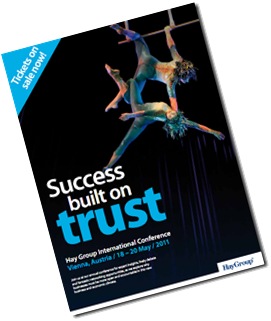
One more thing you can do if you want to increase trust within your organisation, and between your organisation and its stakeholders, is attend this conference organised by Hay Group which is generously sponsoring this blog:


Hay Group International Conference 2011

Success Built on Trust

18-20 May, Vienna Austria

Conference highlights:

  • Latest insights from top business and economic experts
  • Lively, engaging debate on the big issues
  • Finger on the pulse, industry knowledge from Hay Group consultants
  • Superb networking opportunities with other senior leaders
  • Social events including a gala dinner at one of Vienna's cultural highlights.


Speakers:

  • Robin Bew, Editorial director and chief economist, Economist Intelligence Unit
  • Professor Noreena Hertz, Socio-economist
  • Richard Reed, Co-founder, Innocent Drinks
  • Robert Bond, Managing director, Chief distribution officer, UK Retail Distribution, Barclays Bank
  • Dr Nicolas von Rosty, Corporate vice president, Siemens
  • Rob Goffee, Professor of Editorial organisational behaviour director at London
  • Tharuma Rajah, Managing director, Hay Group ASEAN and South Asia
  • Wayne Chen, Managing director, Hay Group North East Asia
  • Peter Cappelli, George W. Taylor, professor of management, Wharton School, University of Pennsylvania
  • Sylvia DeVoge, International client advisor, Hay Group.


For more information about the conference please visit www.thehaygroupconference.com or contact anna.patterson@haygroup.com on +44 (0) 20 7856 7238.

.

This post is sponsored by Hay Group.

Hay Group is a global management consulting firm that works with leaders to transform strategy into reality. The firm develops talent, organises people to be more effective and motivates them to perform at their best. Its focus is on making change happen and helping people and organisations realise their potential.

Hay Group has over 2,600 employees working in 85 offices in 49 countries. Its clients come from the private, public and not-for-profit sectors, across every major industry and represent diverse business challenges.

See more on Hay Group's blog and follow the firm on Twitter.

.

.

.

#HRD11: Social gaming and why I’m catching up on posts


CIPD HRD Angel  For the last couple of days, I’ve been to the CIPD’s HR (HR Development) conference in London.  I was there as press and my intent was to post regularly throughout both days.  Unfortunately my (T-Mobile) dongle wasn’t working and there was no wifi(!), so I wasn’t able to post.  Well, OK, I suppose I was able to draft some posts, but I probably needed the positive reinforcement of seeing my posts out there, and getting your reaction to these, to continue writing - without this ability I find it hard to motivate myself in the same way.

Ben Betts of HT2 would understand.  I met Ben earlier in the day and attended some of his workshop this afternoon as well.  His company produces cost-effective social games for companies, linking both online and face-to-face aspects to produce real and imaginative learning opportunities for business professionals (a bit like Second Life without the nerd factor, or L’Oreal’s Reveal without the £1m+ cost!).

For example, as well as the system they provide actors playing the part of company executives, and a telephone number and ‘receptionist’ that people can call (the company in the scenario we discussed isn’t performing that well so it actually works out quite well when there’s nobody available to answer the call!).

We also discussed Archrival’s perspectives that I posted on earlier this week, and going back a bit further, Byron Reeves’ book Total Engagement.  I wrote in my post on this that I thought these perspectives just a bit far fetched, noting that just because gaming is engaging doesn’t mean business needs to become a game to improve engagement.  I think Ben tended to agree with my assessment - there are things we can learn from games, in order to improve on-line learning, and improve business performance too.  But let’s not take this too, too far.

One of the things we can learn about is intrinsic motivation.  Ben and I discussed Dan Pink’s book, Drive and Ben agreed on my note about the importance of relatedness and it being a shame that this was filtered out in Pink’s work.  Ben suggested the key factors behind engagement are autonomy, competence and relatedness.

Gaming meets all of of these needs – it helps people see how they’re progressing and keeps them motivated to continue this progression.  As I wrote in the new book I’ve co-authored with Dave Ulrich et al:

“…in gaming, which is increasingly being introduced and adapted into organisations and in which being provided with instant feedback produces immediate, or at least short-term, performance improvement.”


Or, as Archduke’s Hull noted, “there’s nothing fun about learning, what’s fun is applying what you’ve learned”.

Blogging may not quite the same thing as a social game, but it’s not completely disconnected from this either. Just like with gaming, it’s the social feedback that’s most important – without this, it’s just no fun, and hence no posting earlier.


Picture credit: @cipd_events


  • Consulting - Research - Speaking  - Training -  Writing
  • Strategy  -  Talent  -  Engagement  -  Change and OD
  • Contact  me to  create more  value for  your business
  • jon  [dot] ingham [at] strategic [dash] hcm [dot] com

.

Wednesday, 6 April 2011

Executive Guide to Integrated Talent Management


  I’m delighted to announce the publication of a new book, The Executive Guide to Integrated Talent Management, edited by ASTD’s Pat Galagan and I4CP’s Kevin Oakes.

The book focuses on the need for better integration between learning & development and the other different areas within HR and includes chapters from various thought leaders including Dave Ulrich,  Beverly Kaye, Peter Cappelli, Ed Lawler, Marshall Goldsmith, John Sullivan, Noel Tichy… and me.

These thought leaders pieces are then paired with articles from senior practitioners, including Annemarie Neal at Cisco, Jayne Johnson from Deloitte, Karl Heinz Oehler from Hertz, Kevin Wilde from General Mills, Leslie Joyce from Novelis, Karen Paul from 3M, Robert Kovach from Cisco and Teresa Roche from Agilent.

My chapter is on the intersection between learning and development and compensation & rewards.

I’ll give you my overall opinions when I get hold of a copy.


More about me:

Also develop your Strategic HCM capabilities at my new Strategic HR Academy


Social Business Summit: Millennial trends for HR


DSCN2951  I’ve recently attended Dachis Group’s Social Business Summit in London (see my two posts at Social Advantage) and thought I’d post here on one of the sessions which was presented by Charles Hull at Archrival.

The sessions was titled Social Marketing to Millennials which didn’t get my hopes up.  I’m not a Gen Y denier (like some) but I tend to think I know as much as I need to on this subject.  However, it was actually quite an interesting session.

Hull talked about tracking trends emerging in the millennial generation (for example, not so long ago, ‘The Facebook’) which tend, without too long a delay, to have a big impact on the rest of us as well.  These trends currently include:

  • Life tracking - fun ways for millennials to track, measure and get analytics on their data (Hull mentioned Bedpost as an example).  There’s an obvious link to performance management here – eg by providing access to tools like Rypple to enable millennials and others to track their performance.
  • Middle class of fame – noting that the 15 minutes of fame ideology has gone from an aspiration to an expectation.  This can be about fame within an individual’s social circle – not necessarily on a national / global scale.  The HR link is to recognition – providing a thanks for performance on a public not just a personal level.
  • Digidentity – the use of social channels to establish individuals’ identities and demonstrate their social currency.  For example, there is a growing trend for millennials to manage their Facebook profiles as a sort of resume – they’re savvy about protecting their identify within different circles of their network.  They’re also savvy about using new social tools to share achievements and accomplishments.  There’s an obvious link to organisation’s use of social sites within recruitment, but the organisational impact is perhaps clear.  But perhaps there’s an opportunity to allow millennials and others to use corporate networking sites to meet this need.
  • Tech-eyed view - every moment is ripe for posting and sharing – millennials are always looking for the next profile pic, and like to use digital tools to entertain, assist and inform themselves and their friends.  Hull took us through some examples of social gaming and how they can be used for marketing purposes.  And I’ve previously posted on the use of games for organisational use.  The key for Hull is to make these games easy to learn but difficult to master (“”There’s nothing fun about learning, what’s fun is applying what you’ve learned”).


See my two posts from the Summit on Social Advantage, and two more on further social business conferences that I’ll be participating in:


  • Consulting - Research - Speaking  - Training -  Writing
  • Strategy  -  Talent  -  Engagement  -  Change and OD
  • Contact  me to  create more  value for  your business
  • jon  [dot] ingham [at] strategic [dash] hcm [dot] com

.

Tuesday, 5 April 2011

International Human Resource Management Congress, Banjul, Gambia


   But from 18-22 July, I’ll be speaking at what may turn out to be my favourite conference so far – the International Human Resource Management Congress at the famous 'five star' Kairaba Beach Hotel in Banjul, Gambia:

The program will introduce to the participants best practices in human resource management (HRM) which are characterized by “long-term perspective' and “people-centered” approaches. In addition, the program will provide opportunities for the participants to share issues on recent changes in management practices in response to the global economic development. The participants are expected to apply some of the lessons learned during the program to the issues of their own organization in their home countries after the program.

Participants at this congress will:

  • Enhance understanding of International human resource management practices with their basic philosophies for sustainable growth.
  • Re-define issues or identify new issues concerning HRM in respective organizations by applying concepts and methodologies learned during the program.
  • Build understanding of a five-step framework for developing business strategy.
  • Improve skills to identify where and how HR can affect each step of the strategic process.
  • Update and sharpen their strategic HR thinking by listening to world class HR speakers.
  • Learn and benefit from a rich exchange of ideas with peers from Africa, Middle East and Asia about different perspectives from diverse industries, cultures and geographies.


For further details see:


Register at www.hallmarkcorporatetraining.com/registration.


  • Consulting - Research - Speaking  - Training -  Writing
  • Strategy  -  Talent  -  Engagement  -  Change and OD
  • Contact  me to  create more  value for  your business
  • jon  [dot] ingham [at] strategic [dash] hcm [dot] com

.

Monday, 4 April 2011

Economist Talent Management Summit


  Then on 9th June I’ll be blogging from the Economist’s Talent Management Summit where this blog is acting as supporting media.

Speakers include:

  • Robert Guest, Business Editor, The Economist
  • Susan Peters, Vice-president, Executive Development & Chief Learning Officer, GE
  • Roger Cude, Senior Vice-president, Global Talent Management, Walmart
  • Hugh Mitchell, Chief Human Resources and Corporate Officer, Royal Dutch Shell
  • Gareth Williams, Human Resources Director, Diageo
  • Bob Bennett, Vice-president and Chief Learning Officer, Global Organisational Learning, Development and Safety, FedEx Express
  • Pierre Barnabé, Executive Vice-president, Corporate Human Resources and Transformation, Alcatel-Lucent
  • Deborah Baker, Group Director for People, BSkyB
  • Phil Smith, Chief Executive Officer, Cisco UK & Ireland
  • Stephen Carver, Lecturer in Project Management, Cranfield School of Management
  • Jane Datta, Director, Workforce Strategy, NASA
  • Linda Seber, Director of Human Resources EMEA, The Boeing Company
  • Robin Bew, Editorial Director & Chief Economist, Economist Intelligence Unit
  • Geraldine Haly, Group Head, Leadership Effectiveness and Succession, Standard Chartered
  • Rafael Ramirez, Fellow in Strategy and Director of the Oxford Scenarios Programme
  • Saïd Business School
  • Satish Pradhan, Executive Vice-president Group HR, Tata Sons
  • Mark Spelman, Global Head of Strategy, Accenture
  • John Ainley, Group HR Director, Aviva
  • Chris Johnson, UK Human Capital Leader, Mercer
  • Santiago Alvarez de Mon, Professor of Managing People in Organisations
  • IESE Business School


Look out for posts on some of these speakers’ sessions then.


As a reader of this blog, you can get a 15% discount on booking using the code SHCM.

And if you do book, let me know, and hopefully we can meet.


  • Consulting - Research - Speaking  - Training -  Writing
  • Strategy  -  Talent  -  Engagement  -  Change and OD
  • Contact  me to  create more  value for  your business
  • jon  [dot] ingham [at] strategic [dash] hcm [dot] com

.

Sunday, 3 April 2011

Pan-European HR Forum


  The first event I’ll be attending after my quiet April, and Connecting HR’s second unconference on 5th May, will be on 9-10th May when I’ll be delivering a workshop on social business and HR management at the European HR Forum in Brussels.

Other speakers include:

  • Pieter Haen, President, EAPM - European Association for People Management & Secretary General World Federation of People Management Associations WFPMA
  • Marc Weedon, Senior Director - Human Resources, EMEA, Polycom
  • Annemie Ress, Senior Director, Human Resources, Europe, eBay Marketplaces
  • Jennie Monon, Senior Global Business Partner, ING
  • Stephan Thoma, Global Learning and Development Director, Google
  • Paul Herrick, Managing Director, Human Resources, EMEA, Burston Marsteller
  • Katrine Smith, HR and Talent Director, EMEA, Panasonic
  • Nigel Martin, HR VP EMEA, Groupe Aeroplan
  • Debra Corey, Senior Director Compensation & Benefits, EMEA, Quintiles
  • Rui M C Ventura, Global HR Director - JLL Hotels & Director - EMEA Human Resources, Jones Lang LaSalle
  • Andy Moffat, European HR Director, Aviva
  • Nicholas David Bearfield, Director, European Communities Personnel Selection Office (EPSO), Belgium
  • Michael Puri, Head of Talent, Learning & Development, International & Europe, Staples
  • Oliver Roentgen, Director Learning Strategy, TNT Learning Centre and Managing Director, TNT Academy
  • Katherine Noall, Human Resources Director EMEA, Information Builders, Netherlands
  • Ben Bengougam, Vice President Human Resources Europe Operations, Hilton Worldwide
  • James Purvis, Head of Recruitment, Programmes & Monitoring, CERN, Switzerland.


Let me know if you’re going to be there, it would be good to say hi.


  • Consulting - Research - Speaking  - Training -  Writing
  • Strategy  -  Talent  -  Engagement  -  Change and OD
  • Contact  me to  create more  value for  your business
  • jon  [dot] ingham [at] strategic [dash] hcm [dot] com

.

Saturday, 2 April 2011

HR as “Human Relationships”: Creating Value through People Management and the Social Network


   The CIPD has still got some away to go in its development before I feel very comfortable paying my fees each Summer, but recent developments show it’s moving in the right direction.  The new website is a vast improvement and I like the new monthly People Management too.  It could do with just a couple more articles still, but those that this edition includes are pretty good.


The Social Network

I particularly like the article ‘Organisational Learning: The Social Network’ from Alexander Fliaster, whose session at HRD2011 this week promises to be one of the conference’s best.

Fliaster argues that innovation needs to be developed through networks of friendship and collaboration (also see my recent post on teams plus networks and communities vs individuals or listen to my recent webinar):

“Companies have to pay particular attention to facilitating friendships that create bridges across organisational ­structural holes and therefore are particularly conducive to knowledge creation. Regular meetings between departments, teams that cross functional and geographic borders, job rotation, off-site conferences, as well as training workshops at which people from various organisational silos come together, can contribute to building ties across the structural holes.

Corporate HR can create more and better conditions for informal contacts among employees by giving them a chance to meet one another and deepen collegial relationships. Social events such as the Christmas party or sports and recreation facilities cannot, of course, make an employee like a colleague and build an emotionally intense friendship. But they can create opportunities for people to run into one another in an atmosphere free from workload and time pressure and start to talk to one another. Training focused on social skills is also of critical importance.

Collaborative relationships with smart and creative colleagues enrich the knowledge and strengthen the cognitive abilities of individuals, increasing work performance. HR managers who still hang on to the individualistic view of creative performance should start to rethink.”


I think this is all absolutely correct, though I also suggest that social collaboration has multiple benefits beyond just innovation (all organisational strategies are ultimately social as far as I can see otherwise they’re unlikely to be ‘organisational’ - vs just a group of individuals - at all).

And I’d have liked to have seen more suggestions for HR developing collaboration beyond organising meetings and social events.  Christmas parties are important but they’re not what I would seize on to develop better connection, or my own strategic role!


On My Agenda (Charlie Johnston, Cisco – pictured)

Some of these are provided in this article on Cisco’s recent focus on business collaboration:

“Our global chief executive, John Chamber, took all the global directors off-site to San Francisco and shared the direction of the organisation for the next five years, as well as the fundamental shift we would see towards Web 2.0 collaboration, says Johnston. “He said this would be the biggest shift that the company would ever have to make, and that we as leaders would need to step up to this new reality – we would need to embrace this technology and lead differently, and he would need to lead differently too.

This heralded a move away from autocratic leadership toward collaborative decision-making, from functions and silos in isolated country branches to cross-departmental, global teamworking. One result is that employees now spend half their time working from home, while over 40 per cent are located in a different city to their manager. On the ground in the UK, Johnston was instrumental in changes that saw leaders hoicked out of their private offices and put into new open-plan environments. The majority of employees could now wear whatever they liked to work and some could even turn up whenever they wanted – a move that caused some leaders to leave the business, in search of more traditional organisations. Those left behind were eager to enter a new world of collaborative leadership, but weren’t quite sure where to start.

Johnston points to the importance of video communication as an example of the type of behaviour needed to lead in a connected global company. Leaders who once ran a small team in a single office could now find themselves leading a team of remote workers dispersed around the globe. We have to get leaders to step up to how they can lead in this new kind of environment. When someone is working remotely, communication becomes more important, and using video becomes really important – people still want to see their leader.”


I love what Cisco has been doing, which is why I’ve already posted on them so many times:


But of course as these posts point out, video is only part of the solution.  It’s a shame that neither Alexander Fliaster’s nor Charlie Johnston’s article mentions Twitter for example.


Insight Led HR

The other thing that’s missing from these two articles is a clear explanation of how internal networks and collaboration provide competitive advantage.

This article from the CIPD’s Bridge consultancy (spit!) almost provides this missing piece.  Borrowing heavily from my value triangle, the article describes a pyramid showing the different levels on which HR can operate:


“Future HR leaders will need to break away from the ‘one model fits all’ orthodoxy if they are to fully exploit the function’s unique vantage point and build organisations to last. In the latest phase of the Next Generation HR programme, a more discerning vision is coming into focus

Most of HR’s heritage is in the bottom two layers, which in concert look to drive consistent performance through the people levers. Moving up, HR starts to place increasing emphasis on examining the fitness for purpose of the business now and in the future. The focus here is ultimately about supporting an organisation to do what is needed to drive performance that lasts. The reality means HR often operating well “off piste” in areas where the organisation most needs to help itself if lasting performance is to be achieved.

These ‘total pyramid’ leaders tend to look at HR as an applied business discipline with a people specialism. They are trying to answer two big questions at any given time. How fit for today is this business? And how fit for tomorrow is it? HR professionals are not simply slaves to the processes, history and client expectations that they encounter. Instead they build an agenda unique to their context, business-focused in its feel and balanced between the needs of today and tomorrow.”


I agree totally and passionately with the CIPD’s perspectives around purpose (POV), insight and differentiation (“an outbreak of HR orthodoxy has happened by stealth and we are in danger of calling this best practice”) but actually, I also think they’ve got a lot of this wrong.

I believe, and demonstrate in my value triangle, that the highest impact comes from really understanding people and the value they can create.  The CIPD’s approach leaves people as resources rather than vital providers of human and, with particularly relevance for this post, social capital.  Social connection and networking is one of the ways this value can be provided – and that’s why the articles by Alexander Fliaster and Charlie Johnston are as important as they are.


I’d have liked to have seen more of a story linking these themes in the magazine together (I don’t think it came out in the editorial).  Maybe it’s up to readers to create their own stories, but I suspect that few HR practitioners know enough about the three topics I’ve addressed here to connect them in the way I’ve suggested above.  I hope they and the connections I have drawn between them have made sense for you.


  • Consulting - Research - Speaking  - Training -  Writing
  • Strategy  -  Talent  -  Engagement  -  Change and OD
  • Contact  me to  create more  value for  your business
  • jon  [dot] ingham [at] strategic [dash] hcm [dot] com

.